
What is Turnstile Antenna: Advantages and Disadvantages
Advertisement
A turnstile antenna is a crossed-dipole antenna configuration that produces circularly or elliptically polarized radiation for communication and broadcasting applications. Its advantages include omnidirectional coverage, circular polarization, and simple construction, whereas its disadvantages include moderate gain, larger physical size, and reduced performance outside its designed frequency range.
Turnstile Antenna : Structure and working
A turnstile antenna is a type of array antenna typically operating in the 30MHz to 3GHz frequency range. To increase directivity, multiple turnstile antennas are often combined.
These antennas can operate in different modes, most commonly:
- Normal Mode: Radiates horizontally polarized waves.
- Axial Mode: Radiates circularly polarized waves.
Turnstile antennas find applications in various fields, including:
- VHF communications
- FM broadcasting
- Military communications
- Satellite communications
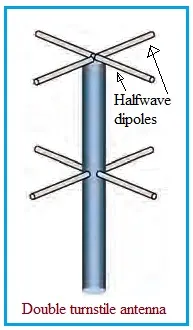
Double turnstile antenna
The image above shows a double turnstile antenna. It consists of two dipoles positioned at right angles to each other. One dipole is connected to a 90-degree phasing cable for quadrature connection. Depending on specific requirements, additional sets of dipoles can be added. The mast is typically made of insulating materials like PVC pipe or wooden dowels.
Benefits or Advantages of Turnstile Antennas
- Simple Construction: Relatively easy to build, as it primarily uses two linear dipoles.
- Higher Gain: When multiple turnstile antennas are stacked, they provide significant gain. A good example is the Super-turnstile antenna.
- Improved Directivity: Offers better directional control of the signal.
Drawbacks or Disadvantages of Turnstile Antennas
- Poor Horizon Performance: Performance is not ideal near the horizon.
- Image Quality Limitations: Optimal image quality is generally limited to a +/-30-degree field of view about the vertical.
- Radiation Power Loss: The radiation power is approximately 3 dB less compared to the maximum radiation of a λ/2 dipole transmitting the same amount of power.
Summary
Turnstile antennas are widely used in satellite communication, FM broadcasting, telemetry, and weather satellite reception because they provide dependable circular polarization and broad coverage. Their antenna advantages improve signal reception in varying orientations, although gain limitations and installation requirements should be considered during system design.
Continue Learning About Antenna Technology
- Antenna Basics Tutorial
- Antenna Related Terms
- Antenna mechanical Vs. electrical tilt
- Difference between antenna gain directivity efficiency
- Antenna gain & effective area
- Bandwidth Vs. beamwidth antenna difference
- Antenna Factor
- Near field Vs. Far field antenna radiation pattern
Explore Different Types of Antennas
-
Check-out: Guide to List of Antenna Types >>