
What is Tunable Laser & its Function in Fiber Optics
Advertisement
A tunable laser is a laser source capable of adjusting its output wavelength over a specified range. Tunable lasers are widely used in optical communications, DWDM systems, spectroscopy, sensing, research and photonic testing applications where precise wavelength selection and flexibility are required. LASER stands for “Light Amplification by Stimulated Emission of Radiation.”
Essentially, a laser is a light source. It generates coherent and near-monochromatic light through stimulated emission. A semiconductor device operating on this principle is called a “Laser Diode.” The primary function of a laser device, or laser diode, is to convert an electrical signal into light. Traditional laser devices are fixed; they don’t offer control over the output wavelength.
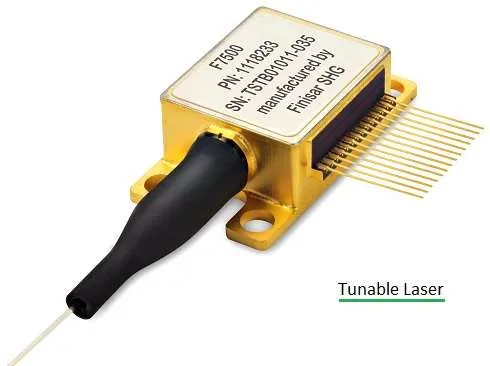
Tunable Laser model Finisar S7500 from QUAGWIRE TECHNOLOGIES LLC
As the image shows, a tunable laser allows for continuous adjustment of the emission wavelength. This gives the user control over the wavelength of the output light signal, which is crucial when using it as an input for transmission over a fiber optic network. In essence, you can “tune” the laser to the optimal wavelength for your application.
Laser Fundamentals & Core Types
Comprehensive overview of how lasers work, including deep dives into the most common gas and solid-state lasers used in labs and industry.
- Types of Lasers: Principles and Applications
- Argon Laser: Advantages and Disadvantages
- CO2 Laser: Advantages and Disadvantages
- He-Ne (Helium-Neon) Laser: Advantages and Disadvantages
- Ruby Laser: Advantages and Disadvantages
- Nd:YAG Laser: Advantages and Disadvantages
Industrial, Defense & Medical Applications
Fascinating use cases showing how laser technology is deployed in modern warfare, quantum computing, dentistry and environmental sensing.
- Laser vs Microwave Weapons
- Laser vs Microwave in Trapped-Ion Quantum Computing
- Diode Lasers in Dentistry: Advantages & Disadvantages
- Laser Methane Gas Sensor
Optical Communication & Photonics
Learn how lasers transmit massive amounts of data across fiber optic cables and through free space.