
What is Ruby Laser: Advantages and Disadvantages
Advertisement
A ruby laser is a solid-state laser that uses a synthetic ruby crystal as its active gain medium to generate coherent red laser light. Its advantages include high output energy and stable operation, while its disadvantages include low efficiency, pulsed operation, and replacement by more advanced laser technologies.
Ruby Laser constuction & working operation
- It’s a solid state laser used for high power applications such as welding, cutting, drilling, and molding.
- The following criteria are essential for the operation of a solid-state laser:
- Sufficient carriers must be pumped from the ground state to a metastable state to enable lasing action. This is achieved by:
- Requiring two energy levels in the active amplifying medium. Doped ionic levels act as the metastable state.
- Using pumping or carrier inversion for stimulated emission, typically achieved by high-energy flash lamp excitation.
- Optical feedback provided by external mirrors or electro-optic crystals.
- A cooling arrangement to manage heat.
- Sufficient carriers must be pumped from the ground state to a metastable state to enable lasing action. This is achieved by:
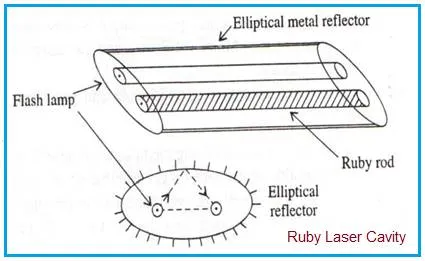 alt: Ruby Laser
- The ruby laser utilizes a ruby crystal as its active or amplifying medium. This crystal is made from aluminum oxide doped with chromium (Cr). The chromium ions (Cr+3) replace aluminum ions (Al) in the Al2O3 lattice, which provides metastable energy states within the solid-state medium.
- Figure 1 (not included here, but described) illustrates a typical ruby laser cavity arrangement. It consists of a cylindrical ruby crystal rod and a cylindrical flash lamp housed along the focal lines of an elliptical reflector. This configuration ensures that reflected light from the lamp effectively excites the crystal rod.
- Population inversion is achieved through flash lamp irradiation of the ruby rod. The flash lamp consists of a quartz tube filled with a noble gas. Helical-type flash lamps are sometimes employed in specific ruby laser types for even more effective carrier pumping.
- Water coolant is necessary to maintain the stability of this high-power laser system.
- Flashlight intensity depends on several factors, including capacitor size, applied voltage, tube diameter, gas pressure, and gas type.
- When a ruby laser is operated in pulse mode, it is possible to obtain very high power light output. In summary, pumping is accomplished using flash lamps, and the laser operates in a pulsed regime.
Benefits or Advantages of Ruby Lasers
- They are economical.
- The beam diameter of a ruby laser is comparatively less than that of a CO2 laser.
- The output power of a ruby laser is not as low as that of a He-Ne laser.
- Ruby is in solid form; hence, there is no risk of wasting the active medium.
- Due to their low output power, they are sometimes classified as Class-I lasers, making them suitable as toys for children, decorative pieces, and artistic displays.
Drawbacks or Disadvantages of Ruby Lasers
- Significant stimulated emission does not occur in a ruby laser until at least half of the ground-state electrons have been excited to the metastable state.
- The efficiency of this laser type is comparatively lower than other types.
- The optical cavity of this laser is short compared to other laser types.
Summary
Ruby lasers played a historic role in laser development and continue to serve specialized scientific, industrial, and medical applications. Their performance advantages remain valuable in selected areas, although newer laser technologies provide improved efficiency, versatility, and operational flexibility.
Laser Fundamentals & Core Types
Comprehensive overview of how lasers work, including deep dives into the most common gas and solid-state lasers used in labs and industry.
- Types of Lasers: Principles and Applications
- Argon Laser: Advantages and Disadvantages
- CO2 Laser: Advantages and Disadvantages
- He-Ne (Helium-Neon) Laser: Advantages and Disadvantages
- Nd:YAG Laser: Advantages and Disadvantages
Industrial, Defense & Medical Applications
Fascinating use cases showing how laser technology is deployed in modern warfare, quantum computing, dentistry and environmental sensing.