
What is Nd-YAG Laser: Advantages and Disadvantages
Advertisement
An Nd:YAG laser is a solid state laser that uses neodymium doped yttrium aluminum garnet as the gain medium. It is widely used in medicine, manufacturing, welding, cutting, and scientific applications due to its high power and precision. Disadvantages include higher system cost, cooling requirements, and potential safety risks from laser exposure.
Structure & Working principle of Nd-YAG Laser
- Its structure and working operation are similar to the ruby laser.
- It utilizes Neodymium doped with Yttrium Aluminum Garnet (i.e., Nd:Y3Al5O12) as the active material. Nd3+ ions are used to achieve the necessary metastable states. It’s used in various scientific and medical fields.
- The Nd:YAG laser emits a lasing output wavelength of about 1.064 µm. This wavelength region is referred to as the near-infrared region. The laser also emits light at other wavelengths.
- This laser type can be used in CW (Continuous Wave) and pulse modes with a peak power of about 1000 Watts and about 2 x 10⁸ Watts, respectively.
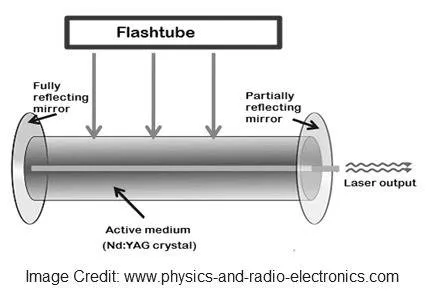
- Figure 1 depicts the structure of an Nd:YAG laser. As shown, it consists of an energy source (e.g., flashtube or laser diodes), an active medium (Nd:Y3Al5O12), and an optical resonator.
- The energy source supplies energy to the active medium in order to achieve population inversion. The crystal is placed between two mirrors, which are optically coated or silvered.
- This laser is a four-level laser system. This means four energy levels are employed in the laser action.
Benefits or Advantages of Nd-YAG Laser
- It is very useful for thin materials for quick processing.
- It offers high DPI (dots per inch) capabilities.
- It is also useful for applications that need high power density, such as metal marking.
- It offers higher energy output and a very high repetition rate.
- It is very easy to attain population inversion.
- It can be Q-switched for CW or pulse mode operations. This helps in minor laser ablation processes.
- Nd:YAG laser machines can cut very high reflecting materials, e.g., aluminum, copper, non-ferrous metals, which can’t be cut by other laser cutting machines.
- It is easy to operate and maintain.
- The purchasing cost is relatively lower.
Drawbacks or Disadvantages of Nd-YAG Laser
- It is not ideal to be used for materials that have moderate thickness.
- Slow production is possible for thicker materials using this laser type. Hence, it offers lower efficiency.
- It has low absorption of radiation of lighter materials very close to the visible spectrum.
- It will not allow for a larger scan gap despite high engraving resolutions. This makes the process slower.
- The electron energy level structure of Nd3+ in YAG is complex.
Summary
Nd:YAG lasers provide high power, excellent beam quality, and versatile industrial and medical applications. Learn the advantages and disadvantages of Nd:YAG laser technology, including precision processing, deep penetration, operational complexity, and maintenance requirements.
Laser Fundamentals & Core Types
Comprehensive overview of how lasers work, including deep dives into the most common gas and solid-state lasers used in labs and industry.
- Types of Lasers: Principles and Applications
- Argon Laser: Advantages and Disadvantages
- CO2 Laser: Advantages and Disadvantages
- He-Ne (Helium-Neon) Laser: Advantages and Disadvantages
- Ruby Laser: Advantages and Disadvantages
Industrial, Defense & Medical Applications
Fascinating use cases showing how laser technology is deployed in modern warfare, quantum computing, dentistry and environmental sensing.