
RMI vs. HSI Aircraft Indicators: Understanding the Differences
Advertisement
This document outlines the differences between Radio Magnetic Indicator (RMI) and Horizontal Situation Indicator (HSI) systems used in aircraft navigation.
RMI - Radio Magnetic Indicator
RMI stands for Radio Magnetic Indicator. Essentially, it points towards radio navigation stations, similar to how an Automatic Direction Finder (ADF) indicates the direction of a Non-Directional Beacon (NDB).
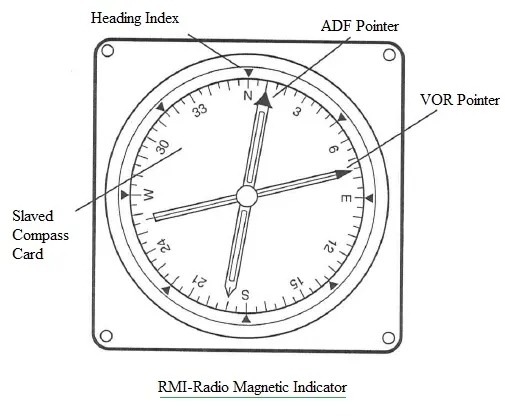
For the RMI to function correctly, it requires the aircraft’s heading information. By comparing the aircraft’s heading with the VOR (VHF Omnidirectional Range) radial, pilots can determine their bearing from the aircraft to the VOR station.
The figure above shows a typical RMI. Notice the two pointers; one commonly indicates the direction to a VOR station, while the other points toward an NDB. The ADF pointer specifically indicates the NDB’s location.
RMIs are particularly useful during approach landings, when altering course, and when switching navigation references – for instance, transitioning from VOR to NDB navigation.
HSI - Horizontal Situation Indicator
HSI stands for Horizontal Situation Indicator. It’s a more sophisticated instrument offering a broader range of navigational information compared to the RMI.
Here are some key characteristics and features of an HSI:
- Directional Gyroscope: Provides accurate aircraft heading information.
- Warning Flags: Alerts the pilot to any unreliable information being displayed.
- Manual Adjustment of Aircraft Heading: Allows pilots to set the desired aircraft heading.
- Manual Adjustment to Tuned Ground Station: Enables selection of specific ground stations for navigation.
- Horizontal and Vertical Guidance: Provides essential guidance during the approach and landing phases of flight.
Continue Learning Radio Navigation Systems (VOR, DME, TACAN & More)
Deep dives into the radio-based beacons, direction finders, and navigation systems that have guided aircraft for decades.
- ADF (Automatic Direction Finder) Basics
- VOR (VHF Omnidirectional Range) Basics
- DME (Distance Measuring Equipment) Basics
- TACAN (Tactical Air Navigation) System Basics
- VORTAC (VOR + TACAN) Navigation
- DME vs TACAN Air Navigation
- RNAV (Random or Area Navigation)
- LORAN (Long Range Navigation) Basics
- OMEGA Navigation System
- DNS (Doppler Navigation System)
- INS (Inertial Navigation System)
- Dead Reckoning Navigation System Basics
- Dead Reckoning Navigation Method
Precision Landing Systems
Explore More Aeronautical Communications & Satellite Navigation Fundamentals
- Air Traffic Management Explained: A Deep Dive into ATM & LDACS
- AeroMAC: Aeronautical Mobile Airport Communications System
- Avionic Systems & Navigational Aids
- B-AMC: Broadband Aeronautical Multi-Carrier Communication
- What is DGPS (Differential Global Positioning System)?
- GNSS vs GPS: Understanding the Difference
- Satellite Navigation: Advantages & Disadvantages