
ADF (Automatic Direction Finder) Basics
Advertisement
The ADF, or Automatic Direction Finder, is a short-range navigational aid used in aviation. It provides aircraft bearing information relative to a ground station called an NDB (Non-Directional Beacon).
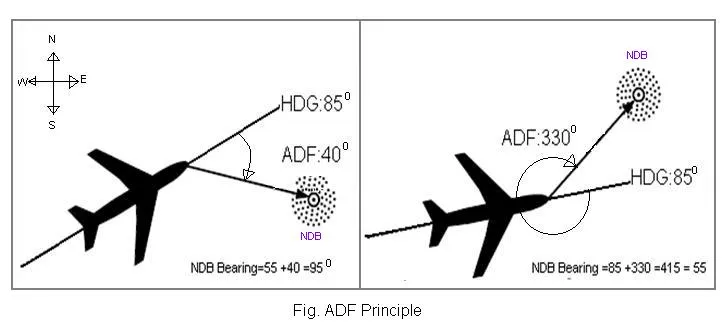
The bearing is measured clockwise from the aircraft’s longitudinal axis to the NDB. The reading displayed in the cockpit indicator is called the ADF bearing, which is a relative bearing.
To determine the NDB’s magnetic bearing, we use the following calculation:
NDB Magnetic Bearing (with respect to Aircraft) = Aircraft Magnetic Heading + ADF Relative Bearing
Applications of ADF
ADF has several key applications in flight:
-
Track Intercept: Used to get back on track when encountering crosswinds.
-
Station Homing: Navigating directly toward or away from an NDB. Be cautious: improper station homing, where the ADF bearing aligns with the aircraft’s longitudinal axis, can result in a curved path due to crosswinds.
- Correct Station Homing:
- Estimate the wind drift angle (approximately 5 degrees) to return to the original track.
- Add an extra angle (around 3 degrees) to compensate for future crosswinds once the track is regained.
- Correct the aircraft heading to fly at 90 degrees + 5 degrees + 3 degrees = 98 degrees.
- Path correction is achieved when both the ADF and the heading needles remain constant.
- Correct Station Homing:
-
Triangulation Position Fix: Determining the aircraft’s location using multiple NDBs.
- Tune the ADF receiver to an NDB.
- Obtain the ADF bearing.
- Calculate the NDB magnetic bearing.
- Calculate the NDB true bearing.
- Draw a corresponding line on a map.
- Repeat these steps using another NDB station.
- The intersection of the lines indicates the aircraft’s 2D position.
ADF Specifications
Ground Station (NDB) Specifications:
- Frequency of operation: 220 to 550 Hz
- NDBs transmit a Morse code identifier for aircraft ADF receivers.
Aircraft ADF Specifications:
- Frequency of operation: MF from 550 to 1750 KHz, covering the commercial AM broadcast band.
- The ADF bearing needle points only to the tuned NDB.
- When flying directly towards an NDB, the ADF bearing pointer indicates 000 degrees.
- When flying directly over an NDB, the ADF bearing pointer indicates 180 degrees.
Advantages
- ADF is not subject to line-of-sight limitations because it operates in the MF band.
Disadvantages
- Ground wave error can be approximately +/- 5 degrees, while sky wave error can be +/- 30 degrees.
- Quadrantal error, caused by radio wave bending due to the aircraft’s metal structure, can reach a maximum of +/- 10 degrees.
- During nighttime, lower ionospheric layers can create strong sky waves, leading to significant errors. It’s best to limit the use of ground stations during these times.
- Terrain, such as mountains and coastal regions, can affect ADF accuracy due to signal reflections.
- Rain, snow, and thunderstorms can interfere with antenna operation and overall ADF system performance.
Continue Learning Radio Navigation Systems (VOR, DME, TACAN & More)
Deep dives into the radio-based beacons, direction finders, and navigation systems that have guided aircraft for decades.
- ADF (Automatic Direction Finder) Basics
- VOR (VHF Omnidirectional Range) Basics
- DME (Distance Measuring Equipment) Basics
- TACAN (Tactical Air Navigation) System Basics
- VORTAC (VOR + TACAN) Navigation
- DME vs TACAN Air Navigation
- RNAV (Random or Area Navigation)
- LORAN (Long Range Navigation) Basics
- OMEGA Navigation System
- DNS (Doppler Navigation System)
- INS (Inertial Navigation System)
- Dead Reckoning Navigation System Basics
- Dead Reckoning Navigation Method
Precision Landing Systems
Explore More Aeronautical Communications & Satellite Navigation Fundamentals
- Air Traffic Management Explained: A Deep Dive into ATM & LDACS
- AeroMAC: Aeronautical Mobile Airport Communications System
- Avionic Systems & Navigational Aids
- B-AMC: Broadband Aeronautical Multi-Carrier Communication
- What is DGPS (Differential Global Positioning System)?
- GNSS vs GPS: Understanding the Difference
- Satellite Navigation: Advantages & Disadvantages