
What is Microwave Diathermy Procedure : Working, Advantages and Disadvantages
Advertisement
Microwave diathermy is a therapeutic technique that uses microwave energy to generate deep tissue heating for pain relief, muscle relaxation, and rehabilitation treatments. It is commonly used in physiotherapy and sports medicine. Advantages include effective deep heating and non-invasive treatment, while disadvantages include contraindications and the risk of excessive tissue heating.
How Microwave Diathermy Work
The term “diathermy” originates from the Greek language, meaning “through heating.” It involves applying a high frequency electromagnetic current to generate deep heating within body tissue. This induced heat produces physiological effects beneficial for therapeutic purposes. Diathermy can help relieve pain, accelerate the healing of infections, and promote relaxation.
Microwave diathermy specifically utilizes microwave frequencies ranging from 300 to 3000 MHz, with corresponding wavelengths of 1 meter to 10 mm. Common microwave frequencies used in these devices include:
- 2450 MHz frequency with 12.33 cm wavelength
- 915 MHz frequency with 32.7 cm wavelength
- 433.9 MHz frequency with 69 cm wavelength
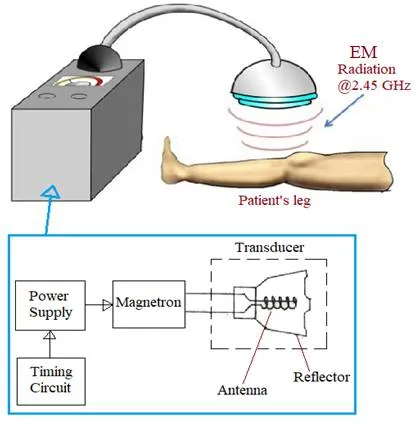
The image above illustrates a microwave diathermy generator and its internal components. As shown, it comprises a power supply, timing circuit, magnetron, and transducer. The device directs the waves onto the targeted tissues. The antenna, with its specialized head design, focuses the field directly at the treatment area. High-frequency waves are generated by a magnetron with tiny perforations through which electrons flow towards the treatment heads. These waves then pass through the space and are absorbed, heating the tissues at the desired depth.
The effective depth of microwave penetration is approximately 4.5 cm, placing it between infrared (~2 cm) and shortwave diathermy (>5 cm).
The treatment parameters for microwave diathermy include:
- Spacing of applicators: 2-6 cm for small treatment areas, 10-15 cm for large treatment areas
- Time of treatment: 20 to 30 minutes
- Frequency of treatment: Daily or on alternate days, depending on the patient’s response, condition, and availability.
Stepwise guide for Microwave Diathermy Procedure
Microwave diathermy is commonly used in physiotherapy and rehabilitation for treating musculoskeletal disorders. The procedure should always be performed by a trained healthcare professional after assessing the patient’s condition and ensuring that no contraindications are present. Following Step-by-Step procedure is followed.
- Patient Assessment : Identify the affected body part, determine treatment goal and review medical history. This ensures the treatment is safe and appropriate for the patient.
- Preparation of Equipment : Common therapeutic microwave frequencies include 915 MHz and 2450 MHz as mentioned above, which are internationally allocated for medical use. Verifies that the equipment is functioning correctly. This ensures safe and efficient delivery of microwave energy.
- Preparation of the Patient : The patient is positioned comfortably so that the treatment area is fully exposed. The patient is informed about the sensations expected during treatment, typically a comfortable feeling of warmth. This is done to improve treatment effectiveness and minimize the risk of burns.
- Positioning the Applicator : The microwave applicator is placed facing the treatment area. This helps to deliver microwave energy accurately to the target tissue.
- Selection of Treatment Parameters: The treatment settings are selected based on nature of disease, size of treatment area, tissue depth etc. The typical parameters include Power output (low, medium, or high), Treatment duration (commonly 10–20 minutes) and Continuous or pulsed mode (if available).
- Administration of Microwave Therapy : After confirming proper positioning, the therapist starts the microwave output. If discomfort occurs, treatment is stopped immediately and settings are reassessed.
- Monitoring During Treatment : Continuous observation is essential throughout the procedure. The therapist monitors patient comfort, skin condition, signs of excessive heating etc. The purpose is to prevent adverse effects and ensure patient safety.
- Completion of Treatment : At the end of the prescribed treatment time, microwave output is switched off. The applicator is moved away from the patient.
- Post Treatment Evaluation : After treatment, the therapist reassesses the patient. The evaluation includes pain relief, improvement in joint mobility, reduction in muscle spasm, patient feedback regarding comfort, skin inspection etc.
Safety Precautions
- Remove all metallic objects before treatment.
- Avoid directing microwave energy toward the eyes, reproductive organs, or areas with impaired sensation.
- Do not use the therapy over implanted electronic devices such as pacemakers.
- Ensure proper applicator distance and alignment.
- Never leave the patient unattended during treatment.
- Follow the manufacturer’s operating guidelines and prescribed treatment parameters.
Benefits or Advantages of Microwave Diathermy
- The technique and machine operation are straightforward and user-friendly.
- It doesn’t require pads, electrodes, capacitor pads, or inductive coils, as is the case with shortwave diathermy.
- It produces a more localized and concentrated heating effect compared to shortwave diathermy.
- It offers more superficial tissue heating, depending on the specific type of tissue involved. It is strongly absorbed by tissues with a high fluid content, such as muscle or blood, leading to significant heating at a superficial depth of around 0.7 cm. Tissues with low fluid content, such as fat or bone, experience greater penetration.
- The patient doesn’t become part of the circuit in microwave diathermy, eliminating the need for tuning as required in shortwave diathermy.
- It’s a very comfortable treatment method for patients.
- Overheating is preventable when proper precautions are followed.
- Low-frequency microwaves cause selective heating in muscles.
Drawbacks or Disadvantages of Microwave Diathermy
- No metal should be within 4 feet of the microwave diathermy device, as it can interfere with the signal.
- Various factors influence heat absorption, including water content, frequency, distance, and the principles of reflection, refraction, absorption, and the inverse square law.
- It’s not suitable for treating deep structures within the body.
- Only one area of the body can be treated at a time.
- There’s a risk of skin burns if treatment procedures and safety guidelines are not strictly followed.
- Patients should avoid looking directly at the applicator during treatment to prevent burns. It is recommended that patients wear microwave goggles.
Summary
Microwave diathermy is a controlled therapeutic heating technique that uses microwave electromagnetic energy. Advantages include pain reduction, reduce muscle spasm, and improved circulation, while disadvantages include overheating risks and restrictions for certain patients.
Continue Learning Microwave Fundamentals & Communication Systems
- Microwave Frequency: Advantages & Disadvantages
- Microwave Communication: Advantages & Disadvantages
- Microwave Backhaul Overview
- Microwave Transmission KPIs (Key Performance Indicators)
- Microwave Transmission Line Basics
- Microwave Coaxial Line Basics
- Microwave Semiconductor Devices
- Microwave Semiconductor Materials Comparison