
What is Short Wave Diathermy: 5 Advantages and Disadvantages
Advertisement
Short wave diathermy is a physiotherapy treatment that uses high frequency electromagnetic energy to generate therapeutic heat within deep body tissues. Its advantages include pain relief, improved blood circulation, and accelerated healing, while its disadvantages include contraindications for certain patients, equipment cost, and the need for professional supervision.
Short Wave Diathermy Procedure or Method
Diathermy refers to the therapeutic treatment of muscular and joint pains. The term itself means “through heating,” indicating that heat is generated to treat tissues within the body. This process stimulates blood circulation, relieves pain, and enhances the rate of recovery in healing tissues.
There are various methods of diathermy, including short wave, long wave, microwave, ultrasound, and laser. Short wave diathermy utilizes electromagnetic (EM) waves at high frequencies (approximately 10-100 MHz) to produce heat. It can be applied in either a pulsed or continuous mode.
Short wave diathermy is used to treat pain from conditions such as sinusitis, kidney stones, and pelvic infections. It can heat tissue to a depth of 2 to 3 cm.
Short wave diathermy primarily uses the following three frequencies:
- 27.12 MHz with a wavelength of 11 meters (most commonly used)
- 13.56 MHz with a wavelength of 22 meters
- 40.68 MHz with a wavelength of 7.5 meters
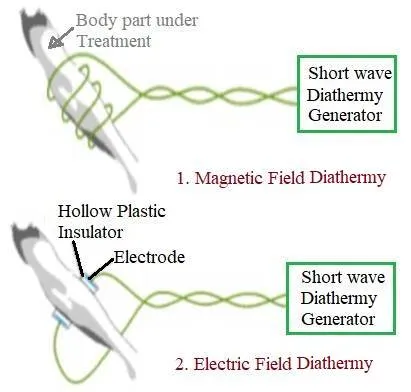
Short wave diathermy uses either capacitor plates (pads) or inductive coils to generate heat using short waves. The capacitive method produces electric fields, while the inductive method produces magnetic fields.
In capacitor based diathermy, pads or electrodes are positioned so that the body part being treated is sandwiched between them. The tissues act as the dielectric material of the capacitor. When short waves are applied, the capacitor generates heat due to dielectric losses within the tissues.
In the inductive coil method, the body part being treated is placed inside the inductive coil. The current flowing within the coil generates a rotating magnetic field, which induces eddy currents in the tissues. These eddy currents cause friction, which in turn generates heat. The inductive method is the more commonly used approach.
Benefits or Advantages of Short Wave Diathermy
- Patient Comfort: This method generally causes less discomfort to patients compared to other methods like hot towels, infrared lamps, or electric heating pads.
- Deep Tissue Healing: It’s effective for relieving pain and promoting the healing of deep-seated sports injuries.
- Direct Application: It can heat through joints and be applied directly to the skin. In contrast, microwave diathermy requires spacing between the skin and the applicator.
- Fat Layer Penetration: It penetrates the fat layer more easily than microwave diathermy (approximately 1/3 the penetration depth of SWD).
- No Hot Spots: It doesn’t create localized “hot spots”.
- Reduced Metal Heating: It doesn’t heat metals as much as microwave diathermy.
Drawbacks or Disadvantages of Short Wave Diathermy
- Risk of Deep Tissue Burn: There’s a risk of deep tissue burns. Burns are more common when using capacitance type electrodes, as the patient becomes part of the circuit.
- Precautions Required: Care should be taken when treating patients with low blood pressure (BP) or gangrene.
- Dosage Sensitivity: An appropriate dose is crucial during treatment, as an overdose can increase pain.
- Safety Concerns: It necessitates greater safety precautions for both the patient and the clinician. Failure to adhere to safety guidelines can lead to inadvertent burns to the patient.
- Equipment Cost: The devices used for short wave diathermy can be expensive.
Summary
Short wave diathermy remains an effective therapeutic modality for managing musculoskeletal disorders, reducing pain, and improving tissue recovery. Its clinical advantages support rehabilitation and physical therapy, although patient suitability, treatment protocols, and safety precautions are essential for successful outcomes.
Explore Specific Treatments & Monitors
- RF Ablation: Uses, Benefits, and Risks
- RF Ablation: Advantages & Disadvantages
- Microwave Ablation
- RF Chemotherapy: Advantages and Disadvantages
- RF Chemotherapy Overview
- Electrosurgery: Advantages and Disadvantages
- Diathermy: Advantages and Disadvantages
- Microwave Diathermy: Advantages and Disadvantages
- Ultrasonic Diathermy: Advantages and Disadvantages
- Digital Blood Pressure Monitor: How It Works
- Electronic Pills: Advantages & Disadvantages
- Myoelectric Prosthesis Arm