
What is Microwave Frequency Range : Advantages and Disadvantages
Advertisement
Microwave frequencies are a portion of the electromagnetic spectrum extending approximately from 1 GHz to 300 GHz, corresponding to wavelengths between 30 cm and 1 mm. They are used in wireless communication, radar, satellite systems, and industrial applications. These frequencies support high capacity data transmission and compact antenna designs. Advantages include large bandwidth availability, while disadvantages include atmospheric attenuation and limited propagation through obstacles.
Key Features of Microwave Frequency
Any frequency above 1 GHz is generally known as a microwave. It usually ranges from 300 MHz to 300 GHz on the scale. Microwave frequencies up to 100 GHz have been used in a wide variety of applications.
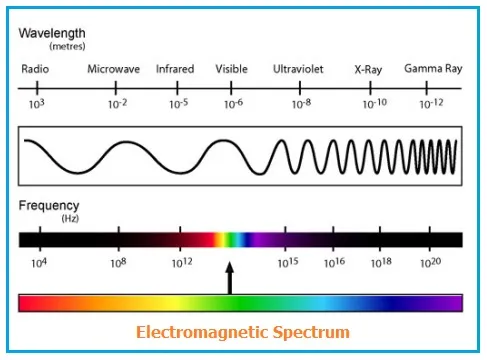
Figure 1 depicts the Electromagnetic Spectrum with frequency and wavelength. Following are the key features of Microwave frequencies:
- Large bandwidth
- Higher Gain
- High Directivity
- Travels in LOS (Line of Sight) mode
- Less noise in the 1 to 10 GHz band
Frequency Bands in EM Spectrum and Microwave frequency range
microwave spectrum is divided into standardized frequency bands identified by letter designations such as L, S, C, X, Ku, K, Ka, V, and W. Each band has distinct propagation characteristics, bandwidth availability, atmospheric attenuation, and suitable applications.
| Band | Frequency Range | Approximate Wavelength | Common Applications |
|---|---|---|---|
| L Band | 1–2 GHz | 30–15 cm | GPS, mobile satellite communication, aviation, radar |
| S Band | 2–4 GHz | 15–7.5 cm | Weather radar, Wi-Fi (2.4 GHz), microwave ovens, satellite telemetry |
| C Band | 4–8 GHz | 7.5–3.75 cm | Satellite communication, TV broadcasting, long-distance microwave links |
| X Band | 8–12 GHz | 3.75–2.5 cm | Military radar, marine radar, weather monitoring, remote sensing |
| Ku Band | 12–18 GHz | 2.5–1.67 cm | Direct-to-home (DTH) television, VSAT, satellite internet |
| K Band | 18–27 GHz | 1.67–1.11 cm | Short-range radar, scientific research, speed detection |
| Ka Band | 27–40 GHz | 1.11–0.75 cm | High-speed satellite internet, 5G backhaul, deep-space communication |
| V Band | 40–75 GHz | 7.5–4 mm | Millimeter-wave communication, high-capacity wireless links |
| W Band | 75–110 GHz | 4–2.7 mm | Automotive radar, imaging systems, remote sensing, scientific research |
Characteristics of Microwave Frequency Range
The microwave spectrum exhibits several common characteristics:
- High frequency electromagnetic waves capable of carrying large amounts of information.
- Wide bandwidth, supporting high speed digital communication.
- Predominantly line of sight (LOS) propagation for terrestrial links.
- Small antenna size due to short wavelengths.
- High antenna gain with directional antennas.
- Increasing atmospheric attenuation and rain fading as frequency increases.
- Frequency reuse through narrow beamwidths, reducing interference.
Major Applications of Microwave Frequency Range
- L band is used in Global Navigation Satellite Systems (GNSS) such as GPS and air traffic control radar etc.
- S band is used in weather radar systems, airport surveillance radar, microwave diathermy etc.
- C band is used in fixed satellite services, satellite TV broadcasting, terrestrial microwave communication etc.
- X band is used in military surveillance radar, marine navigation radar, Synthetic aperture radar, weather observation radar etc.
- Ku band is used in VSAT, direct to home TV, satellite news gathering etc.
- K band is used in police speed radar, vehicle collision avoidance systems etc.
- Ka band is used in high speed satellite internet, 5G, deep space communication, earth observation satellites etc.
- V band is used for wireless gigabit networks, 5G mmwave communication etc.
- W band is used in security screening systems, remote sensing, medical imaging, automotive collision avoidance radar, radio astronomy etc.
Benefits or Advantages of Microwave Frequency
- Microwave frequencies can establish reliable wireless communication which can be used for information transmission. Hence cumbersome wired links can be avoided.
- It has wider bandwidth and hence it can be used for the simultaneous transmission of voice, data, and video channels.
- It has a short wavelength and hence antenna size is smaller and it is light in weight. Hence antennas are installed very easily on any wireless devices including mobile phones, tablets, laptops, aircraft, etc.
- Miniaturized microwave components are available at affordable costs. Moreover, microwave towers do not require much area and hence telecom service providers can save in space/land as well as costs.
- It can generate heat energy which is utilized in many bio-medical applications e.g., skin tightening, cancer treatment, etc. Moreover, it is used in microwave ovens for cooking food.
Drawbacks or Disadvantages of Microwave Frequency
- As it travels in line of sight, it is affected by obstacles such as mountains, tall buildings, etc. This has to be taken care of in RF budget planning.
- The microwave frequencies are attenuated due to various parameters such as rain, snow, and fog, etc.
- The microwave frequencies are reflected from flat & metal surfaces.
- It is diffracted from solid objects.
Summary
Microwave frequencies enable modern wireless, radar, and satellite technologies. Advantages include high data capacity and directional transmission, while disadvantages include weather-related losses and reduced penetration through objects.
Continue Learning Microwave Fundamentals & Communication Systems
- Microwave Communication: Advantages & Disadvantages
- Microwave Backhaul Overview
- Microwave Transmission KPIs (Key Performance Indicators)
- Microwave Transmission Line Basics
- Microwave Coaxial Line Basics
- Microwave Semiconductor Devices
- Microwave Semiconductor Materials Comparison
Explore Non-Telecom Applications: Medical, Heating & Defense
- Microwave Heating Principles & Applications
- Microwave vs Solid State RF Energy Heating Ovens
- Microwave Diathermy: Advantages & Disadvantages
- Microwave Ablation
- High Power Microwave Weapons
- Laser vs Microwave Weapons
- Laser vs Microwave in Trapped Ion Quantum Computing
- Microwave Landing System Basics
- Microwave Sensor vs PIR Sensor