
What is Microwave Ablation : 5 Key Advantages and disadvantages, working
Advertisement
Microwave ablation is a minimally invasive medical procedure that uses microwave energy to generate heat and destroy abnormal tissues, including tumors. It is widely applied in oncology and interventional radiology. Advantages include precise treatment and faster procedures, while disadvantages include equipment costs and potential damage to nearby healthy tissues.
Introduction : It is minimally invasive medical treatment. It uses microwave energy in the range from 300 MHz to 3 GHz for the treatment. It is used to destroy abnormal tissues such as tumors. It’s commonly used in treating liver, kidney, lung and bone cancers.
How Microwave ablation works
Following steps describe microwave ablation procedure followed on patient under treatment.
-
A thin antenna/probe is inserted into the tumor; guided by ultrasound, CT or MRI imaging. The same is also shown in the figure-1 below.
-
The probe delivers microwave energy into the tissue.
-
The microwaves cause water molecules in the cells to vibrate rapidly due to production of frictional heat.
-
This heat is typically in the range from 60 to 150 °C. The heat causes coagulative necrosis which effectively destroys the targeted cancerous cells.
-
The dead tissue is gradually absorbed by the body over time.
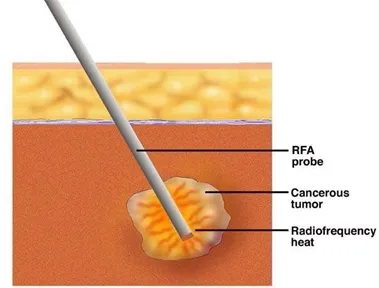 Image alt: Microwave ablation
Advantages of Microwave Ablation
Following are some of the benefits of microwave ablation.
- It offers higher efficiency compared to RF ablation. It heats tissue faster.
- It is less affected by tissue properties. Works well even in tissues with higher impedance such as lungs or bones.
- It is minimally invasive i.e. requires only small probe insertion.
- It can be performed under CT, ultrasound or MRI for precise targeting.
- It requires very short hospital stay.
Disadvantages of Microwave Ablation
Following are some of the drawbacks of microwave ablation.
- It is only effective for small to medium sized tumors. Not suitable for widespread cancer.
- It can cause bleeding, infection or damage to nearby structures such as vessels, nerves if not operated with care.
- The procedure requires specialized equipments and exoertise which is not available in all the hospitals.
- Used mostly for palliative care or local control, especially in patients not fit for surgery.
- It is expensive procedure.
Summary
Microwave ablation treats tumors using targeted thermal energy. Advantages include minimally invasive treatment, shorter recovery times, and effective tissue destruction, while disadvantages include procedural risks, equipment expense, and limited suitability for certain conditions.
Continue Learning Microwave Fundamentals & Communication Systems
- Microwave Frequency: Advantages & Disadvantages
- Microwave Communication: Advantages & Disadvantages
- Microwave Backhaul Overview
- Microwave Transmission KPIs (Key Performance Indicators)
- Microwave Transmission Line Basics
- Microwave Coaxial Line Basics
- Microwave Semiconductor Devices
- Microwave Semiconductor Materials Comparison
Explore Non-Telecom Applications: Medical, Heating & Defense
- Microwave Heating Principles & Applications
- Microwave vs Solid State RF Energy Heating Ovens
- Microwave Diathermy: Advantages & Disadvantages
- High Power Microwave Weapons
- Laser vs Microwave Weapons
- Laser vs Microwave in Trapped Ion Quantum Computing
- Microwave Landing System Basics
- Microwave Sensor vs PIR Sensor