
What is a Luneburg Lens Antenna : Advantages and Disadvantages
Advertisement
A Luneburg lens antenna is a specialized electromagnetic lens antenna that focuses radio waves from multiple directions without mechanical steering. It is used in radar, satellite communication, and aerospace systems. Advantages include wide-angle beam steering and high gain, while disadvantages include large physical size and complex fabrication requirements.
Key Features of Luneburg Lens Antenna
- A Luneburg lens is a spherically symmetric lens characterized by a variable index of refraction.
- A Luneburg lens antenna is constructed using such a lens.
- This antenna radiates a beam in any direction from a feed located opposite the beam.
- The feed phase center is positioned either on the surface of the lens or a short distance away.
- Luneburg lens antennas can be realized as either a full sphere or a hemisphere, as shown in the figure below.
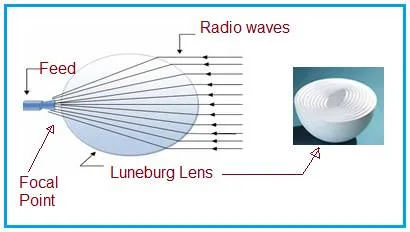
-
The index of refraction when the feed is located on the outer surface of the sphere is expressed as follows:
Where;
- a = lens outer radius
- r = lens inner radius
Benefits or Advantages of Luneburg Lens Antenna
- Rapid Beam Scanning: It facilitates very rapid beam scanning by moving a lightweight feed around the sphere or by switching between multiple feeds.
- Easy Steering: Steering the antenna is easy by moving the feed around the lens without physically rotating the entire antenna, unlike a parabolic dish antenna.
- Multiple Feeds for Wide Directions: Due to its spherical symmetry, a single Luneburg lens can be used with several feeds looking in widely different directions, unlike parabolic reflectors where multiple feeds are used within a small angle of the optical axis.
- Broadband Operation: It offers broadband operation.
- Inexpensive Materials: It is manufactured using inexpensive dielectric materials.
- No Active Elements: It does not use any active elements, making it less expensive.
Drawbacks or Disadvantages of Luneburg Lens Antenna
- Feed Blockage: While it can generate multiple beams by feeding the lens from various places, there is a restriction due to blockage caused by other feeds or support structures.
- Large Size: It tends to be large in size.
- Dielectric Losses: It incurs relatively large dielectric losses.
- Complex Fabrication: It is complex to fabricate.
Summary
A Luneburg lens is a spherical electromagnetic lens with a radially graded refractive index, enabling it to focus and steer beams without physical movement. Its key benefits include wide angle scanning, high gain, low profile design and broadband capabilities, making it a valuable technology in 5G, satellite, radar and aerospace systems.
Continue Learning About Antenna Technology
- Antenna Basics Tutorial
- Antenna Related Terms
- Antenna mechanical Vs. electrical tilt
- Difference between antenna gain directivity efficiency
- Antenna gain & effective area
- Bandwidth Vs. beamwidth antenna difference
- Antenna Factor
- Near field Vs. Far field antenna radiation pattern
Explore Different Types of Antennas
-
Check-out: Guide to List of Antenna Types >>