
Fabry-Perot vs. Distributed Feedback Lasers: Key Differences
Advertisement
In fiber optic communication, the laser diode serves as a crucial optical source, emitting photons to carry data. Lasers, an acronym for “Light Amplification by Stimulated Emission of Radiation,” produce light of a single wavelength in a narrow beam. This article will explore the differences between two common types of lasers: Fabry-Perot (FP) lasers and Distributed Feedback (DFB) lasers.
Fabry-Perot Laser
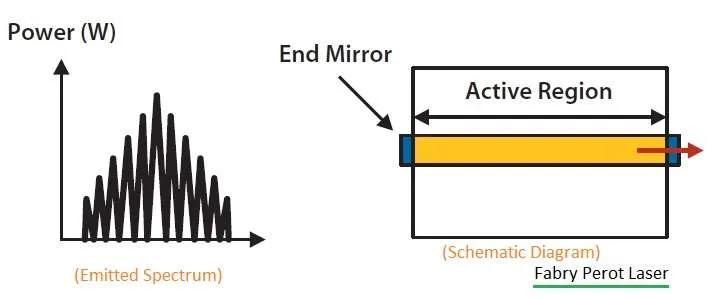
Figure 1 illustrates the emission spectrum and schematic diagram of a Fabry-Perot Laser. Here are its key characteristics:
- Common Type: The Fabry-Perot laser is one of the most widely used laser diode types.
- Applications: Used in Optical Time Domain Reflectometer (OTDR) design.
- Cost-Effective: Generally less expensive than DFB lasers.
- High Output Power: Can deliver a higher output power level.
- OTDR Use: Commonly used in single-mode OTDR applications at wavelengths like 1310 nm, 1550 nm, and 1625 nm.
- Spectral Width: Emits light at various discrete wavelengths, resulting in a spectral width between 5 nm and 8 nm.
- Harmonics: Emits a considerable amount of harmonics across the 5 nm to 8 nm wavelength range.
Distributed Feedback Laser
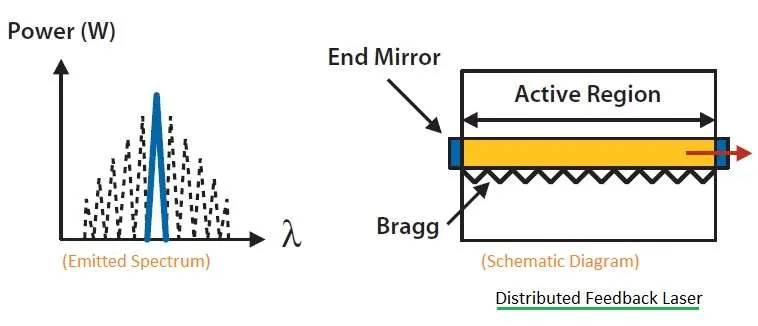
Figure 2 shows the emission spectrum and schematic diagram of a Distributed Feedback Laser. The key characteristics of this DFB laser type include:
- Precision: Offers more precise wavelength control compared to FP lasers.
- Lower Output Power: The output power capability is typically lower than that of FP lasers.
- Narrow Spectral Width: Selects only one principal wavelength from the FP laser spectrum, resulting in a narrow spectral width of less than 0.1 nm.
- Bragg Grating: Functions similarly to an FP laser but includes a Bragg grating inside the cavity between the two end mirrors. This grating acts as a wavelength-selective filter.
In essence, while both Fabry-Perot and Distributed Feedback lasers serve as optical sources, they differ significantly in their precision, output power, and spectral characteristics. FP lasers offer higher power and affordability, while DFB lasers excel in applications requiring precise wavelength control and narrow spectral width.
Laser Fundamentals & Core Types
Comprehensive overview of how lasers work, including deep dives into the most common gas and solid-state lasers used in labs and industry.
- Types of Lasers: Principles and Applications
- Argon Laser: Advantages and Disadvantages
- CO2 Laser: Advantages and Disadvantages
- He-Ne (Helium-Neon) Laser: Advantages and Disadvantages
- Ruby Laser: Advantages and Disadvantages
- Nd:YAG Laser: Advantages and Disadvantages
Industrial, Defense & Medical Applications
Fascinating use cases showing how laser technology is deployed in modern warfare, quantum computing, dentistry and environmental sensing.
- Laser vs Microwave Weapons
- Laser vs Microwave in Trapped-Ion Quantum Computing
- Diode Lasers in Dentistry: Advantages & Disadvantages
- Laser Methane Gas Sensor
Semiconductor & Solid-State Lasers (Diodes)
Explore the compact, highly efficient diode lasers used in everything from barcode scanners to high-speed data transmission.
- Semiconductor Lasers: Advantages and Disadvantages
- Diode-Pumped Lasers Overview
- Diode-Pumped Solid-State (DPSS) Laser Explained
- PCSEL (Photonic Crystal Surface-Emitting Laser): Working, Design & Applications
- Fabry-Perot vs Distributed Feedback (DFB) Lasers
- News: Nuvoton Technology Introduces UV Semiconductor Laser
Optical Communication & Photonics
Learn how lasers transmit massive amounts of data across fiber optic cables and through free space.