
Internal vs. External Light Modulation : Advantages and Disadvantages
Advertisement
Internal and external light modulation are techniques used in optical communication systems to encode information onto light signals. Internal modulation occurs within the laser source, while external modulation uses separate modulators. Advantages vary in simplicity, speed, and signal quality, while disadvantages involve cost, complexity, and performance trade-offs.
Introduction: Light modulation involves altering the irradiance (amplitude, phase, pulse width, etc.) or direction of light as it travels through a medium. Different light modulation techniques cater to diverse application needs.
Comparison between Internal and External Modulation
-
Internal Modulation: In this approach, the light output from sources like LEDs or lasers is directly controlled by injecting or driving current. It utilizes a simpler circuit for this purpose.
-
External Modulation: This method modulates both the amplitude and phase of light from external sources. Processes like electro-optic, magneto-optic, or acousto-optic effects are employed. The polarization status changes due to the presence of external force fields (electric, magnetic, or acoustic). Consequently, the phase or irradiance of the light beam is modified.
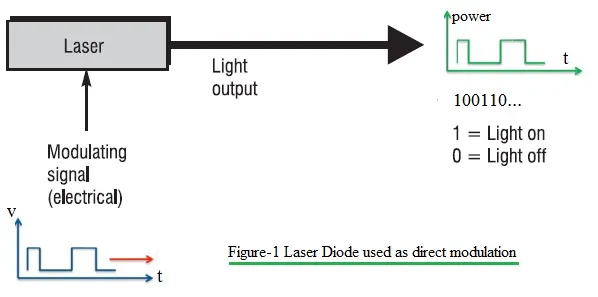 optical direct modulation
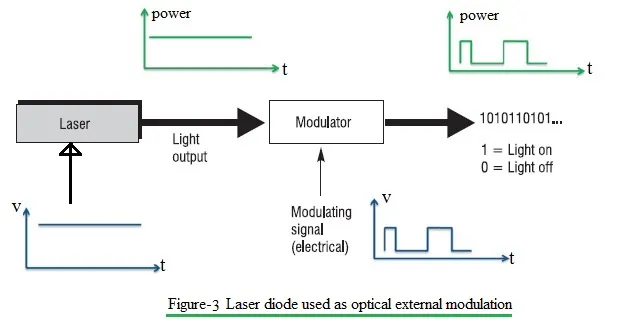 optical external modulation
Advantages and Disadvantages of Internal Light Modulation
Benefits:
- Uses a simple circuit for modulation.
- It’s a very cost-effective method.
Drawbacks:
- Usable up to a frequency of about 40 GHz.
- Shifts the emission frequency by changing the driving current.
- Limited modulation, primarily achieved through amplitude variation.
Advantages and Disadvantages of External Light Modulation
Benefits:
- Higher device speed, controlled by the modulator’s properties.
- Emission frequency remains unaffected, unlike internal modulation.
- Both amplitude and phase modulation are possible.
Drawbacks:
- Larger modulator size compared to micro-electronics standards.
Summary
Internal and external light modulation methods are used in fiber-optic communication systems. Internal modulation offers simplicity, while external modulation provides higher performance at increased cost and complexity.
Continue Learning Modulation Types
- AM Vs. FM Vs. PM : Difference between Analog Modulation Techniques
- ASK Vs. FSK Vs. PSK : Difference between Digital Modulation Techniques
- PAM Vs. PWM Vs. PPM : Difference between Pulse Modulation Techniques
- BPSK Vs. QPSK : Key Differences
- 16-QAM Vs. 64-QAM Vs. 256-QAM : Key Differences
- 512-QAM Vs. 1024-QAM Vs. 2048-QAM Vs. 4096-QAM
- 4096QAM Modulation Used in Wi-Fi 7
- MSK Vs. GMSK : Modulation Technique used in GSM
- LORa Modulation Used in LoRaWAN
- 10% ASK & 100% ASK Modulation used in NFC
- OOK Vs. VPPM Vs. CSK : Visible Light Communication (VLC) Modulation Techniques
- QPSK Vs. OQPSK Vs. PI/4 QPSK
- PAM4 Modulation Used in Gigabit Ethernet
- CCK Vs. DSSS Vs. OFDM Used in WLAN (Wi-Fi) Standards