
What is Semiconductor Laser: 5 Advantages and Disadvantages
Advertisement
A semiconductor laser is a compact solid-state light source that generates coherent laser radiation using stimulated emission within a semiconductor material. Its advantages include small size, high efficiency, and low power consumption, while its disadvantages include temperature sensitivity, beam divergence, and limited output power for certain applications.
Introduction to laser
Lasers are devices that produce intense beams of light that are:
- Monochromatic (single color)
- Coherent (waves in phase)
- Highly collimated (parallel beam)
This allows the light to travel great distances or be focused to a very small spot, achieving brightness higher than the sun. The term “LASER” is an acronym for “Light Amplification by Stimulated Emission of Radiation.”
Semiconductor laser structure and its applications
Semiconductor lasers are compact because they’re made using semiconductor materials with nanomete -scale accuracy. They resemble transistors and operate similarly to LEDs, but the output beam possesses laser light characteristics.
Gallium Arsenide (GaAs) is commonly used in semiconductor lasers, leading to the name gallium arsenide laser or injection laser.
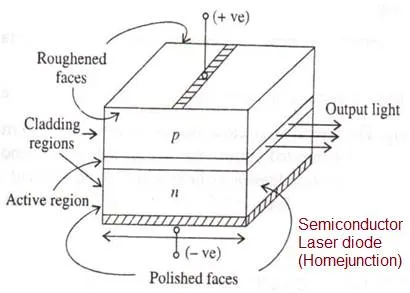
Figure 1: Simple semiconductor p-n junction structure (homojunction laser diode).
In a semiconductor laser diode, optical gain is produced within the semiconductor material. The recombination of injected holes and electrons in a forward-biased p-n junction results in the direct conversion of electricity to light (photon emission).
Multiple reflections of emitted radiation within the optical cavity region help build up photons, which enables sustained stimulated emission from the junction laser diode. When the rate of stimulated emission significantly exceeds the loss rate, the device enters a lasing state, also known as the gain state.
Based on their construction and materials, semiconductor laser types include:
- Simple homojunction laser diode
- DH (Double Heterojunction) laser
- QW (Quantum Well) laser
- DFB (Distributed Feedback) laser
- Tunable laser
- Surface emitting laser
Depending on the laser type, they are used in various applications, such as:
- Storing information on CDs and DVDs
- High-speed data transmission over fiber optic cables
- Welding
- Surgery
- Military applications
- Holography
Semiconductor lasers can be pulsed at varying rates and pulse widths, making them suitable as transmitters for digital data.
Benefits or Advantages of Semiconductor Lasers
- Passive Cooling: They often utilize passive cooling in their design, simplifying thermal management.
- Low Power Consumption: They are energy-efficient and consume less power.
- High Efficiency: They offer excellent efficiency and long operational lifespan.
- Ease of Operation: They are easy to operate and control.
- Cost-Effective: Semiconductor lasers are relatively cheap and economical.
- Long Life and Tunability: They offer long lifespans, produce highly monochromatic light, and can be tunable and provide a continuous beam.
- Compact and Simple: They boast a simple design/construction and are compact in size. Unlike other laser types, mirrors are not always required.
Drawbacks or Disadvantages of Semiconductor Lasers
- Low Power Output: They are not suitable for many high-power applications due to their limited power production.
- Temperature Sensitivity: Their output is significantly affected by temperature changes.
- Unusual Beam Profile: The output beam’s profile can be unusual due to the lasing medium’s small size and rectangular shape.
- High Beam Divergence: Beam divergence is much greater compared to other laser types.
- Cooling Requirements: Cooling requirements can be a drawback in certain applications, although often passive cooling is sufficient.
Summary
Semiconductor lasers are widely used in fiber optic communication, barcode scanners, medical devices, optical storage, and sensing systems because they provide efficient and reliable light generation. Their performance advantages support numerous technologies, although thermal management and beam quality remain important design factors.