
DeMorgan's Theorem: Simplifying Logical Expressions
Advertisement
This page covers the basics of DeMorgan’s Theorem and provides an example application.
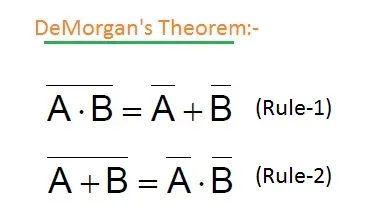
DeMorgan’s Theorem essentially provides a way to simplify logical expressions. It comes in two key rules:
- RULE-1: The complement of a product of terms is equal to the sum of the complements of each term.
- RULE-2: The complement of a sum of terms is equal to the product of the complements of each term.
These rules can be expressed mathematically as follows:
How to Remember?
A simple mnemonic to remember DeMorgan’s Theorem is:
“BREAK THE LINE, CHANGE THE SIGN”
Break the line (the overbar representing the complement) over the variables, and change the sign (AND to OR, or OR to AND) directly under the original line.
Example Application of DeMorgan’s Theorem
Here’s an example demonstrating how DeMorgan’s Theorem can be applied:
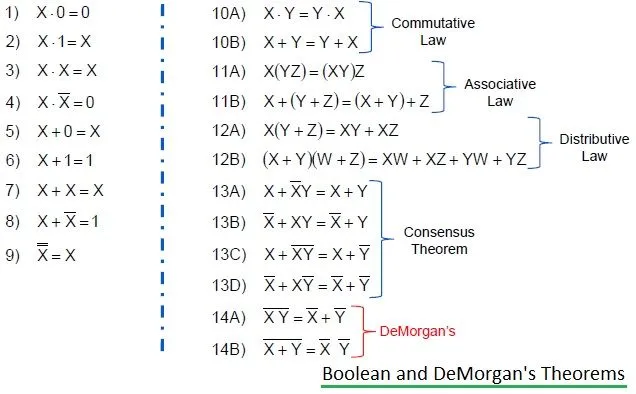
Let’s see how to simplify a Boolean expression using DeMorgan’s Theorem. Consider the following example:
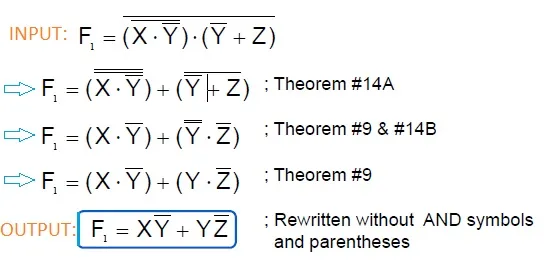
The goal is to use Boolean algebra and DeMorgan’s Theorem to simplify the expression and write the final answer in Sum of Products (SOP) form.
Logic Gates, Flip-Flops & Latches
Deep dives into the foundational logic gates and memory elements (flip-flops/latches) used to build sequential digital circuits.
Source Code of Gates, Flip-flps and Latches (VHDL, Verilog & LabVIEW)
- VHDL Code for Basic Logic Gates
- Verilog HDL Code for All Logic Gates
- D Flip-Flop Synchronous Reset (Verilog)
- D Flip-Flop Without Reset (Verilog)
- T, D, SR, JK Flip-Flop (Verilog HDL Code)
- D Flip-Flop (VHDL Source Code)
- JK Flip-Flop (VHDL Source Code)
- T Flip-Flop (VHDL Source Code)
- D-Latch (VHDL Source Code)
- Flip-Flop Design (LabVIEW VIs)