
Cassegrain Feed Antenna: Function and Basics
Advertisement
This page explains the function and basics of a Cassegrain feed, a common configuration used in antenna systems. As you likely know, a parabolic dish antenna typically consists of a parabolic dish and a horn antenna placed at the focal point.
There are several different configurations for the placement of the horn antenna. One of the most popular arrangements is shown in Figure 1. A waveguide feeds the horn placed at the focal point. The parabolic dish curves around the horn, which acts as a reflector.
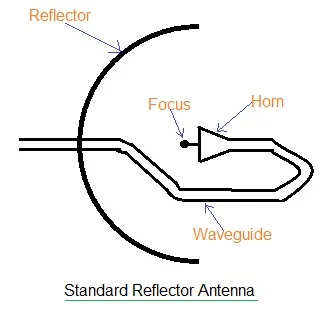
Fig.1 Simple reflector antenna
A popular method for feeding a parabolic antenna involves placing a second reflector at the focal point instead of the horn. The horn’s position is then moved to the center of the larger parabolic dish.
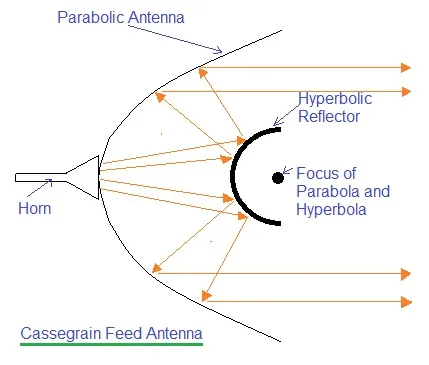
Fig.2 Cassegrain Feed antenna
As illustrated in Figure 2, during transmission, electromagnetic (EM) radiation from the horn is directed toward the smaller reflector first. The smaller reflector then reflects the energy toward the larger dish. The large dish, in turn, radiates the signal in parallel beams. This entire arrangement is known as a Cassegrain feed.
Advantages of Cassegrain Feed
The Cassegrain feed offers several advantages:
- The waveguide line is short.
- Radial bends in the waveguide are no longer necessary.
- Due to the above, the Cassegrain arrangement results in less attenuation and an improved noise figure.
Larger Earth station antennas often utilize the Cassegrain feed arrangement.
Continue Learning About Antenna Technology
- Antenna Basics Tutorial
- Antenna Related Terms
- Antenna mechanical Vs. electrical tilt
- Difference between antenna gain directivity efficiency
- Antenna gain & effective area
- Bandwidth Vs. beamwidth antenna difference
- Antenna Factor
- Near field Vs. Far field antenna radiation pattern
Explore Different Types of Antennas
-
Check-out: Guide to List of Antenna Types >>