
What is Beverage Antenna : Advantages and Disadvantages
Advertisement
A Beverage antenna is a long-wire directional receiving antenna primarily used for low-frequency and shortwave radio communications. It provides excellent directivity and low noise reception. Advantages include superior long-distance signal reception, while disadvantages include large installation space requirements and limited suitability for transmitting applications.
Key features & Structure of Beverage Antenna
-
A Beverage antenna is essentially a long wire stretched horizontally, positioned a fraction of a wavelength above the ground.
-
It’s fed relative to the ground, and the ground plane image of the horizontally polarized wire largely cancels out the far-field pattern.
-
These antennas are typically one wavelength or longer, which is why they’re also known as long wire antennas.
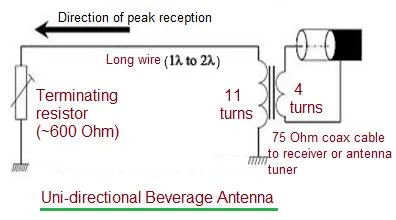 Beverage antenna
-
Figure 1 illustrates a unidirectional Beverage antenna. It consists of a horizontal wire, ranging from λ/2 to several λ in length (where λ is the wavelength).
-
This wire is suspended relatively close to the ground, typically 10 to 20 feet above the surface, and pointed towards the signal source.
-
At the end facing the signal source, the antenna is terminated with a resistor. The value of this resistor is equivalent to the characteristic impedance of the transmission line, usually between 400 and 800 Ohms.
-
The other end of the antenna is connected to the receiver through a transmission line.
-
Beverage antennas are primarily used as receiving antennas for high-frequency (HF) and medium-frequency (MF) radio bands.
Benefits or Advantages of the Beverage Antenna
Here are some key advantages of using a Beverage antenna:
-
Excellent Directivity: They are known for their ability to focus on signals from a specific direction, reducing interference from other sources.
-
Wide Bandwidth of Operation: Beverage antennas can operate effectively over a broad range of frequencies.
-
Inexpensive: They are relatively simple to construct and don’t require expensive materials, making them a cost-effective option.
Drawbacks or Disadvantages of the Beverage Antenna
Despite their benefits, Beverage antennas also have some drawbacks:
-
Large Physical Size: Their length requires a significant amount of land area, which can be a limiting factor.
-
Fixed Direction: It’s not practical to rotate a Beverage antenna to change the receiving direction. They are typically fixed in a single orientation.
-
Multiple Antennas for Wide Coverage: To achieve wide azimuth coverage, you would need to install multiple Beverage antennas, each pointed in a different direction.
Summary
A Beverage antenna is a directional receiving antenna known for excellent long range reception. Advantages include low noise performance, while disadvantages include large physical size and installation constraints.
Continue Learning About Antenna Technology
- Antenna Basics Tutorial
- Antenna Related Terms
- Antenna mechanical Vs. electrical tilt
- Difference between antenna gain directivity efficiency
- Antenna gain & effective area
- Bandwidth Vs. beamwidth antenna difference
- Antenna Factor
- Near field Vs. Far field antenna radiation pattern
Explore Different Types of Antennas
-
Check-out: Guide to List of Antenna Types >>