
What is AMQP Protocol : Advantages and Disadvantages
Advertisement
AMQP (Advanced Message Queuing Protocol) is an open standard messaging protocol designed for reliable communication between distributed applications. It supports message queuing, routing, and interoperability across systems. Advantages include reliability and scalability, while disadvantages include protocol complexity and higher resource consumption compared to lightweight alternatives.
Key features of AMQP & its Architecture
AMQP operates over the TCP layer and utilizes a publish/subscribe architecture, similar to MQTT. AMQP facilitates asynchronous message transfer, making it OS, hardware, and programming language agnostic. It employs optimized data framing with a buffering approach, significantly enhancing server performance. Security is provided through TLS and SASL.
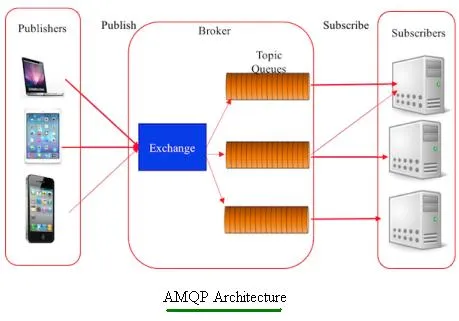
The figure above illustrates the AMQP architecture.
As shown, an AMQP broker includes exchanges and queues. Publishers send messages with specific routing keys to the exchange. The exchange then uses these keys to route messages to the appropriate queues. Messages remain stored in the queues until they are delivered to, or read by, subscribers. Bindings define the rules for connecting exchanges to queues. There are three exchange types: direct exchange, fanout exchange, and topic exchange.
Benefits or Advantages of AMQP
Here are the key benefits of using AMQP:
- Guaranteed Quality of Service (QoS): AMQP uses QoS, ensuring the reliable delivery of important data.
- Established Publish/Subscribe Architecture: AMQP leverages the proven publish/subscribe model, similar to MQTT, for efficient data sharing.
- Interoperability: It guarantees interoperability because it is a wire-level protocol that transmits data as a stream of bytes.
- Simplified Peer-to-Peer Communication: AMQP facilitates straightforward peer-to-peer communication, even with intermediaries.
- Evolvability: The protocol is designed to adapt and work with evolving standards.
- Secure Connections: AMQP offers secure connections to users through protocols like SSL, similar to CoAP, MQTT, HTTP, and XMPP.
Drawbacks or Disadvantages of AMQP
Despite its strengths, AMQP has some drawbacks:
- Lack of Backward Compatibility: AMQP is not backward compatible with older versions, which may create issues when integrating with legacy systems.
- Complexity: It is more complex than simpler wire protocols like HTTP 1.0 or HTTP 1.1.
- Higher Bandwidth Requirements: AMQP typically requires more bandwidth compared to lightweight protocols like MQTT, CoAP, or XMPP.
- Limited Resource Discovery: Unlike CoAP, HTTP, and XMPP, AMQP lacks built-in support for resource discovery.
Summary
AMQP enables reliable message exchange between distributed systems. Advantages include scalability and interoperability, while disadvantages include complexity and increased resource requirements.
Continue Learning IoT Protocols
- MQTT Architecture: Message Types, Format, Flow
- CoAP Protocol Architecture & Messages Exchanged between client & Server
- DDS Architecture & its protocol stack layers
- AMQP Architecture Components & Frames
- REST Protocol Vs. SoAP
- XMPP Protocol & Server-Client Interaction
- LWM2M : Key Advantages and Disadvantages
- 6LoWPAN Mesh Network & Protocol Stack
- RPL vs CORPL vs CARP: IoT Routing Protocol Comparison
- HTTP Vs. HTTPS : Key Comparison
- FTP Protocol Basics : key advantages & disadvantages
- Ping vs. Ping6: IPv4 and IPv6 Connectivity
- SFTP Vs. SCP : key Differences
- SSL Vs. SSH : Key Comparison
- MPTCP Protocol : Key Advantages & Disadvantages
- What is QUIC (Quick UDP Internet Connections)?
- TCP-IP Packet Format & its fields with example
Compare IoT Protocols
- MQTT Vs. DDS Protocol
- MQTT Vs. REST Protocol
- MQTT Vs. SMQTT
- CoAP Vs. MQTT : Key Differences
- CoAP Vs. HTTP : Comparison between them
- SFTP Vs. FTPS
- FTP Vs. HTTP : Key Differences between them
- FTP Vs. TFTP (Trivial File Transfer Protocol)
- FTP Vs. SMTP
- AMQP (Advanced Message Queuing Protocol) Vs. JMS(Java Message Service)
- TCP Vs. Multipath TCP (MPTCP)