
What is EC-GSM IoT: Features and Applications
Advertisement
EC-GSM-IoT (Extended Coverage GSM Internet of Things) is a cellular IoT technology developed to support low power devices using existing GSM networks. It provides enhanced coverage, low deployment costs, extended battery life and reliable connectivity for smart metering, industrial monitoring, asset tracking and IoT applications. This page explains EC-GSM IoT basics including its features, applications and benefits in the context of Internet of Things (IoT).
Introduction to EC-GSM IoT
EC-GSM IoT stands for Extended Coverage GSM for Internet of Things. It is a Low Power Wide Area (LPWA) technology standardized and published in 3GPP Release 13. It operates within licensed spectrum, similar to traditional GSM technology.
An EC-GSM IoT network is backward compatible with existing GSM networks, utilizing the existing GSM architecture as illustrated in Figure 1.
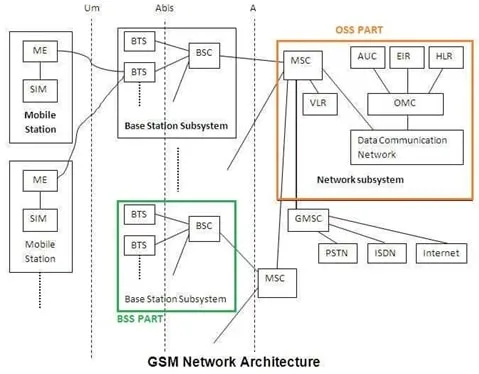
To enable EC-GSM IoT functionality, software upgrades are required on the existing GSM network, device, and core network sides. A consortium of companies is actively working to make 3GPP-based EC-GSM IoT technology widely available. This group includes prominent names like Intel, Cisco, Ericsson, Broadcom, LG, KDDI, MediaTek, Orange, Nokia, Sierra Wireless, and Samsung Electronics, Telit communications.
EC-GSM IoT Features
EC-GSM supports four coverage classes.
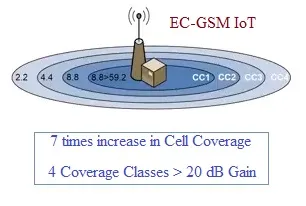
The following table summarizes the key features of EC-GSM IoT technology:
| Features | Description |
|---|---|
| Frequency | Same as GSM network, 850 to 900 MHz, 1800 to 1900 MHz |
| Deployment | In-Band GSM |
| Access Type | TDMA/FDMA |
| Modulation Types | GMSK, 8PSK |
| Bandwidth | 200 KHz per channel |
| Peak Data Rate (Downlink/Uplink) | 70 Kbps for GMSK, 240 Kbps for 8PSK |
| Coverage | 164 dB with 33 dBm Power Class, 154 dB with 23 dBm power class |
| Duplexing | HD, FDD |
| Power saving mode | PSM, ext. I-DRX |
EC-GSM IoT Applications
EC-GSM IoT is suitable for various applications, including:
- M2M/IoT traffic only
- Voice
- Data
- SMS
EC-GSM IoT Benefits
EC-GSM IoT technology offers several benefits and advantages:
- Long battery life: Up to approximately 10 years.
- Lower device cost: Compared to existing GSM/GPRS devices.
- Variable rates: Utilizes GMSK/8PSK modulation.
- High subscriber capacity: Supports approximately 50,000 devices per cell.
- Improved security: Compared to GSM/EDGE.
Changes/Additions Compared to Existing GSM/GPRS
Significant changes and additions have been implemented to adapt GSM/GPRS for IoT applications:
- Physical Layer changes
- New Logical channels
- Overlaid CDMA to enhance cell capacity which is used for EC-PDTCH and EC-PACCH
References
- 3GPP GERAN TR 45.820, section 10 - 3rd Generation Partnership Project
- 3GPP TS 43.064 V13.0.0 - Overall description of the GPRS radio interface
Continue Learning EC-GSM (Extended Coverage GSM IoT)
Learn how legacy 2G/GSM networks are being adapted to support massive Internet of Things (IoT) deployments with extended range and lower power consumption.