
What is DECT NR+? Features, Benefits & Applications
Advertisement
DECT NR+ is a completely new wireless radio technology standard developed by the European Telecommunications Standards Institute (ETSI). In 2021, the International Telecommunication Union (ITU) officially included it in the IMT-2020 technology family, confirming it meets the rigorous requirements for 5G connectivity.
Unlike cellular 5G, which relies on base stations and telecom operator subscriptions, DECT NR+ is designed for private, decentralized, and autonomous networks. It is highly versatile, application agnostic (meaning it natively supports standard protocols like IPv6, TCP, UDP, and OPC-UA), and specifically engineered to support two primary 5G use cases:
- mMTC (massive Machine Type Communication): Supporting massive IoT networks with thousands to millions of devices.
- URLLC (Ultra-Reliable Low Latency Communication): Delivering millisecond latency for mission critical and real time operations.
While it shares part of its name with “classic DECT” (the technology behind cordless landline phones) and can peacefully coexist with it on the same spectrum, DECT NR+ is a complete technology redesign built for the modern IoT era.
Key Features
-
Autonomous Mesh Topology: DECT NR+ operates on a decentralized, clustered tree mesh network. Devices (nodes) can communicate directly with one another and autonomously decide the best route to send data to the internet (the sink). There is no need for a central network coordinator.
-
Advanced Radio Technology: The physical layer (PHY) utilizes CP-OFDM (Cyclic Prefix Orthogonal Frequency Division Multiplexing) combined with advanced Turbo channel coding and Hybrid ARQ (HARQ). This ensures highly reliable, error corrected data transmission.
-
Flexible Spectrum & Scalability: It operates in frequency bands below 6 GHz, including the dedicated 1.9 GHz DECT band, globally available ISM bands, and various licensed or unlicensed sub-GHz ranges. It intentionally avoids the heavily congested 2.4 GHz band (used by Wi-Fi and Bluetooth).
-
Variable Bandwidths & Speeds: Depending on the configuration, channel bandwidths can scale from 1.728 MHz up to 221 MHz, enabling data rates ranging from a steady 1 Mbps up to lightning fast 1.3 Gbps.
-
Polite Spectrum Access: The standard features “Listen Before Talk” (LBT) and automatic interference management, allowing devices to sense spectrum use and avoid collisions with other wireless systems.
-
Robust Security: DECT NR+ enforces two independent layers of security. The MAC layer provides link level encryption and integrity protection, while the Convergence (CVG) layer enables end to end security, utilizing AES-128 and CMAC algorithms.
Technical Parameters of DECT NR+
| Parameter | Values |
|---|---|
| Network Topology | Mesh, Star, Point-to-Point |
| Handover Support | Yes |
| Localization Support | Yes |
| Localization Accuracy | Meter-level |
| Frequency Bands | Europe & Asia: 1880–1900 MHz |
| USA & Canada: 1920–1930 MHz (UPCS band) | |
| Korea: 1786–1892 MHz | |
| Japan: 1893–1906 MHz (under discussion) | |
| Unlicensed Frequency Band | Yes (licensed and unlicensed) |
| Standardized | Yes, ETSI TC DECT, 103.636 series |
| Node Types | Leaf, Relay, Sink |
DECT NR+ Network Nodes
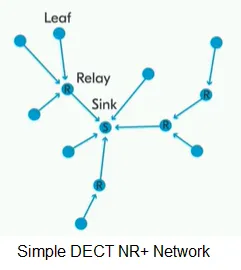
The network consists of three functional nodes viz. sink, relay and leaf. All these three nodes are categorized into FT (Fixed Termination) or PT (Portable Termination) modes.
-
Sink Node (Gateway / Border Router): It operates in FT mode and connects directly with cloud internet or any other backhaul network such as LAN or cellular.
-
Relay Node (Router): It operates in both FT and PT modes at the same time. It acts as a child to a node closer to the Sink, and a parent to devices further away. It receives data from its children and routes it upstream, extending the physical range of the DECT NR+ network.
-
Leaf Node (Child): It operates strictly in PT mode. It acts as standard endpoint device (e.g. temperature sensor). It connects to Relay or Sink nodes. It does not forward traffic for other devices. This mode is often used for ultra-low power, battery operated devices.
Key Benefits of DECT NR+ technology
By bringing 5G capabilities outside of the traditional cellular ecosystem, DECT NR+ offers unique advantages for enterprise and industrial deployments:
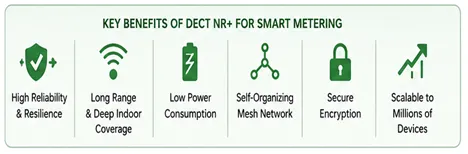
- Minimal Cost of Ownership: Because DECT NR+ can operate in license exempt frequency bands, organizations can build and own their private 5G networks without paying ongoing subscription fees to telecommunications operators or leasing expensive spectrum.
- Self-Forming and Self-Healing: The autonomous nature of the mesh network eliminates the need for extensive RF network planning. Devices automatically detect the best connections, balance network loads, and instantly reroute data if a node goes down or a device moves, drastically reducing onsite maintenance.
- Ultra-Low Latency & High Reliability: For point to point or star topology networks, DECT NR+ can achieve one-way latency of under 1 millisecond. Even in massive multi-hop mesh networks, it ensures rapid data delivery with 99.9% to 99.99% reliability, making it suitable for critical automation.
- Exceptional Battery Life: The protocol is highly optimized for power consumption. Devices even those acting as routing nodes in a mesh can enter deep sleep modes for up to 98 % of the time, waking only for brief, synchronized beacon intervals. This allows for battery operated routing devices that can last for years in the field.
Target Applications
Because its protocol stack is entirely application-agnostic (it natively supports IPv6/UDP/TCP as well as standard industrial protocols like OPC-UA or DLMS), it is highly versatile. Primary use cases include:
- Smart Energy & Metering: Connecting millions of electricity meters reliably over a wide area.
- Industrial IoT (IIoT) & Automation: Robotics, asset tracking, factory automation, and machine condition monitoring (e.g., digital twins).
- Smart Cities & Environments: Environmental sensing, street lighting, and early warning systems.
- High Quality Audio & Voice: Unified communications, professional media production, and speech applications that demand ultra-low latency.
Massive IoT Use Case of DECT NR+
| Parameter | Values |
|---|---|
| Maximum Transmission Unit | 180 bytes |
| Transmission Range | 500 m (per hop) |
| One Way Latency | < 100 ms E2E |
| Maximum One Way Latency | < 500 ms |
| Average Data Rate per Application Device | 0.450 kbps UL; 6.4 bps DL |
| Power Consumption per Application Device | 60 mA |
Summary
DECT-2020 NR is a highly scalable, low cost, and easy to deploy wireless foundation designed to bring 5G-level reliability and massive IoT connectivity to private networks without the need for cellular subscriptions or complex network planning.