
DECT NR+ vs Cellular 5G NR: Key Differences
Advertisement
DECT NR+ (DECT-2020 NR) is a non-cellular 5G radio technology designed by ETSI primarily for private, local area connectivity, Industrial IoT, smart buildings, professional audio and ultra reliable low latency applications. Cellular 5G NR, standardized by 3GPP, is designed for wide area mobile broadband, public and private cellular networks, high data rates, mobility and diverse 5G services.
International Telecommunication Union (ITU-R) defines what officially qualifies as “5G” under its IMT-2020 vision. In 2021, the ITU-R approved a Set of Radio Interface Technologies (SRIT) that included both 3GPP 5G NR and ETSI DECT NR+. Both technologies are officially recognized as 5G standards, but they were built by different organizations to solve completely different connectivity challenges.
What is DECT NR+ (DECT-2020 NR)?
DECT NR+ is the world’s first non-cellular 5G standard, developed by ETSI. It was purpose built to deliver 5G level performance (specifically massive IoT and ultra-reliable low latency) for private, local area networks without the need for cellular infrastructure.
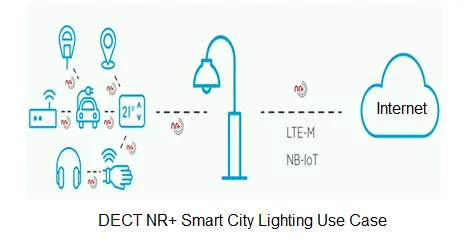
Instead of relying on cell towers, DECT NR+ operates on a decentralized, autonomous mesh network. Every device (i.e. node) in the network can act as a router, forwarding data from other devices until it reaches a gateway connected to the internet.
As it operates primarily in license exempt spectrums such as the globally available 1.9 GHz DECT band and standard ISM bands; businesses can deploy and own DECT NR+ networks without paying subscription fees to telecom operators. They even do not require to buy SIM cards and do not need any expensive spectrum licenses. Example smart city lighting use case of DECT NR+ is shown in the figure-1.
What is 5G NR (New Radio)?
5G NR is the cellular 5G standard developed by the 3rd Generation Partnership Project (3GPP). It is the technology that powers the global public 5G networks used by smartphones and mobile broadband devices today.
5G NR is highly centralized and infrastructure-heavy. It requires a complex architecture consisting of a Radio Access Network (RAN) with massive cell towers (gNBs) and a centralized Core Network (5GC) to route traffic, authenticate users via SIM cards, and manage mobility.
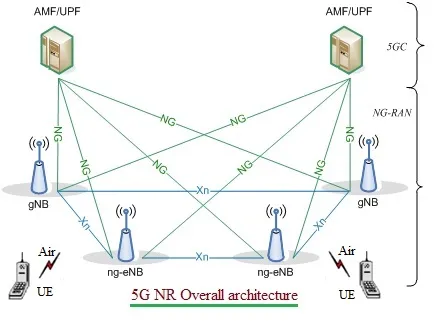
Because of its massive power and range, 5G NR typically operates in licensed spectrum(Sub-6 GHz and mmWave), which telecommunication companies pay billions of dollars to exclusively control.
While 5G NR is heavily optimized for eMBB (Enhanced Mobile Broadband) to deliver gigabit download speeds, businesses can also deploy it as a “Private 5G” network, though doing so requires significant capital for infrastructure, core network software, and localized spectrum rights.
DECT NR+ vs. 5G NR: Key Differences
While both are IMT-2020 (5G) technologies, they serve different operational requirements. 5G NR is a wide area, infrastructure dependent network, whereas DECT NR+ is a local, infrastructure less mesh network.
| Feature / Characteristic | DECT NR+ (Non-Cellular 5G) | 5G NR (Cellular 5G) |
|---|---|---|
| Standardizing Body | ETSI (European Telecommunications Standards Institute) | 3GPP (3rd Generation Partnership Project) |
| Network Architecture | Decentralized / Mesh: Devices act as routers, dynamically forming and healing the network autonomously. | Centralized / Cellular: Devices must connect to a central cell tower (gNodeB) backed by a 5G Core Network. |
| Spectrum Usage | Unlicensed / License-Exempt: Uses free spectrum (1.9 GHz DECT band, 2.4/5 GHz ISM). No spectrum fees. | Licensed: Primarily uses exclusive, auctioned spectrum (Sub-6 GHz, mmWave) to prevent interference. |
| Authentication & Access | Certificate-based: Secure joining via provisioning servers; completely SIM-free. | SIM-based: Requires physical USIMs or eSIMs for subscriber authentication and network access. |
| Primary 5G Focus Areas | mMTC & URLLC: Optimized for massive IoT (millions of sensors) and ultra-low latency industrial automation. | eMBB, URLLC, & mMTC: Heavily optimized for mobile broadband (gigabit smartphone speeds), alongside IoT/latency. |
| Infrastructure Cost | Very Low: No core network required. Devices themselves form the network. Just deploy the nodes and a gateway. | High: Requires significant investment in Base Stations (RAN), antennas, Edge/Core servers, and backhaul. |
| Operating Cost (OPEX) | None / Minimal: You own the network. No data caps, subscription fees, or monthly operator charges. | Recurring: Requires monthly data subscriptions (Public 5G) or ongoing core software/spectrum licensing (Private 5G). |
| Mobility & Handovers | Device-Driven: The end device independently decides to hand over to a better neighboring node based on signal/routing costs. | Network-Driven: The core network and base stations orchestrate the handover of a moving device between towers. |
| Integration / Interworking | Can operate as a standalone private network, or interface with a 3GPP 5G Core via Non-3GPP Interworking Functions (N3IWF). | The native standard for public mobile networks worldwide. |
Conclusion
5G NR is used for wide area, city to city coverage, gigabit broadband speeds (eMBB) for smartphones/video, or are willing to invest heavily in a carrier grade Private 5G infrastructure. DECT NR+ is used for highly scalable, easy to deploy, subscription free private network for massive IoT (like smart metering or smart lighting) or low latency industrial automation inside factories, buildings or localized outdoor areas.