
Difference between DECT NR+ vs Wi-Fi vs Bluetooth
Advertisement
DECT NR+ (DECT-2020 NR) is a non-cellular 5G technology designed for reliable, scalable, low latency connectivity, including industrial IoT, automation, smart buildings and professional audio. Wi-Fi is widely used for high speed wireless local area networking and Internet access requirements. Bluetooth is optimized for short range, low power device to device connectivity and personal area applications. The technologies differ in range, data rate, latency, network topology, power consumption, spectrum, interference characteristics, scalability, and deployment requirements, making each suitable for different wireless applications.
DECT NR+ (DECT-2020 NR)
DECT NR+ is a non-cellular 5G standard recognized by the ITU-R under the IMT-2020 vision to support massive IoT (millions of devices) and ultra reliable, low latency communication (URLLC) for industrial and commercial applications.
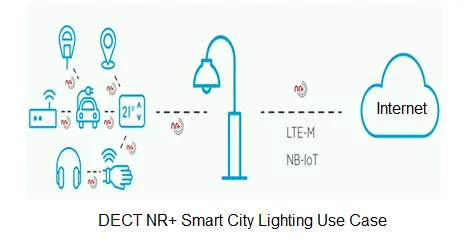
DECT NR+ utilizes an autonomous, decentralized mesh topology. Devices do not need a central router; they communicate directly with one another, automatically routing data across vast distances.
Advantages : Unlike Wi-Fi and Bluetooth, which compete for space in the crowded 2.4 GHz ISM band, DECT NR+ primarily operates in the dedicated 1.9 GHz frequency band. This provides a clean, interference free environment.
Applications : Smart city grids, large-scale electricity metering, autonomous factory robotics, digital twins, and asset tracking across massive industrial complexes.
Wi-Fi (IEEE 802.11)
Wi-Fi is the global standard for Wireless Local Area Networks (WLAN). It is designed to move massive amounts of data at high speeds over relatively short distances, making it the backbone of consumer and enterprise IT networks.
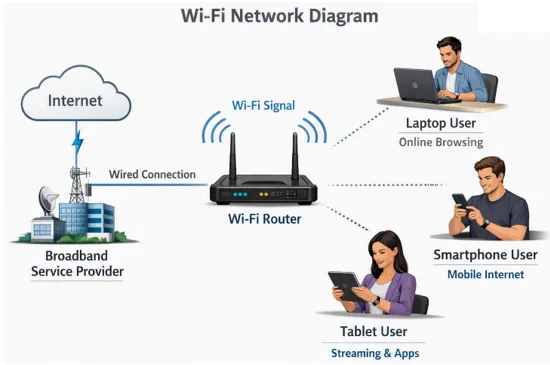
Wi-Fi primarily uses a Star topology, where all devices (phones, laptops, smart TVs) must connect to a central Access Point (AP) or router. While Wi-Fi Mesh exists, it typically uses mesh for the backhaul between routers rather than individual end devices. The figure depicts one such use of wi-fi network. As shown Wi-Fi router is interfaced with broadband service provider or cellular service provider for cloud internet server connectivity.
Advantages : Modern Wi-Fi (Wi-Fi 6, 6E, 7 and 8) operating on 5 GHz and 6 GHz bands can deliver multi-gigabit speeds, making it ideal for video streaming, AR/VR and large file transfers.
Limitations : APs can become easily congested if too many IoT devices connect at once, and it consumes a lot of power.
Applications : Enterprise IT, consumer internet access, high bandwidth video streaming and mobile computing.
Bluetooth & Bluetooth Low Energy (BLE)
Bluetooth is the global standard for Wireless Personal Area Networks (WPAN). It is divided into “Classic” and “Bluetooth Low Energy” or BLE. Classic version is used for continuous audio streaming like wireless headphones. BLE version is ideal for IoT sensors and wearables.
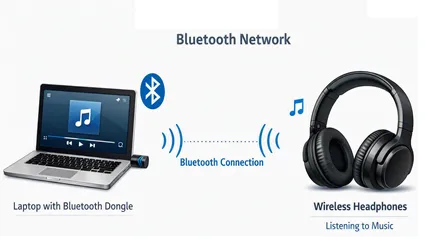
Bluetooth generally operates on a Point to Point basis (e.g. your headphone to laptop as shown or your phone to your smartwatch). It also supports Bluetooth Mesh, which is often used in smart home environments. Bluetooth operates exclusively in the globally shared 2.4 GHz band.
Advantages : BLE is exceptionally power efficient and cheap to implement, making it the default choice for battery powered consumer peripherals.
Limitations : it has short range and it struggles with reliability in highly congested RF environments such as crowded factory floor.
Applications : Consumer wearables, wireless audio, smart home lighting, beacons and short range personal peripherals.
Comparison: DECT NR+ vs. Wi-Fi vs. Bluetooth
| Feature | DECT NR+ | Wi-Fi (Wi-Fi 6/6E/7) | Bluetooth (BLE / Mesh) |
|---|---|---|---|
| Standard Type | 5G / IMT-2020 (Industrial/IoT) | WLAN (Local IT/Broadband) | WPAN (Personal/Peripherals) |
| Primary Focus | Massive IoT & Industrial Automation | High-speed data & internet access | Wearables, Audio, & Short-range IoT |
| Network Topology | Autonomous Mesh (Clustered Tree) & Star | Star (Relies on central Access Points) | Point-to-Point & Managed Mesh |
| Frequency Bands | 1.9 GHz (Dedicated), plus Sub-6GHz | 2.4 GHz, 5 GHz, 6 GHz (Shared ISM) | 2.4 GHz (Shared ISM) |
| Interference Level | Very Low: Uses dedicated spectrum and dynamic channel selection. | High to Medium: 2.4 GHz is very crowded; 5/6 GHz are better but shorter range. | High: Shares the crowded 2.4 GHz band with Wi-Fi and microwaves. |
| Range / Coverage | City-wide / Massive: Multi-hop mesh allows infinite range extension. | Medium: ~30 to 100 meters from the Access Point. | Short: ~10 to 30 meters (up to 100m line-of-sight for certain classes). |
| Scalability (Density) | Massive: Supports up to millions of nodes per network (mMTC). | Moderate: Access Points get congested with too many simultaneous devices. | Low/Moderate: Good for personal clusters or small smart home setups. |
| Power Consumption | Ultra-Low: Deep sleep modes allow mesh routing on battery power. | High: Devices require frequent charging or mains power. | Ultra-Low (BLE): Coin-cell batteries can last for years. |
| Data Rates | 1 Mbps up to 1.3 Gbps (Scalable based on bandwidth/modulation). | Gigabit+ (Ideal for heavy video/IT workloads). | 125 kbps to 2 Mbps (BLE limits). |
| Latency | < 1 millisecond (URLLC for critical control). | Variable: 10ms - 50ms (Subject to network congestion/buffering). | Variable: Generally higher latency in mesh configurations. |
Summary
Wi-Fi is your best choice for high bandwidth tasks like streaming 4K video or connecting laptops in an office. Bluetooth is ideal for personal, short range connections like wireless earbuds, smartwatches and local smart home sensors.DECT NR+ sits in a new category which is the best choice when you need the reliability and scale of a cellular 5G network. DECT NR+ is used to connect city grid of smart meters or to deploy low latency robots in a factory but want the simplicity and cost effectiveness of an unlicensed, self-forming mesh network.