
DECT NR+ Tutorial: Network Architecture, Protocol Stack & Security
Advertisement
DECT-2020 NR (also commonly referred to as DECT NR+) is a new wireless radio technology standard developed by the European Telecommunications Standards Institute (ETSI). It is notably recognized as the world’s first non-cellular 5G standard. Unlike traditional cellular 5G which requires expensive cell towers and SIM card subscriptions, DECT NR+ empowers businesses to build their own private, self healing mesh networks in license free spectrums.
In 2021, the International Telecommunication Union (ITU-R) officially recognized DECT-2020 NR as a Radio Interface Technology (RIT) that fulfills the IMT-2020 (5G) requirements. It is specifically designed to address two major 5G use cases:
- mMTC (massive Machine Type Communication): Supporting dense networks with thousands of devices (massive IoT).
- URLLC (Ultra-Reliable Low Latency Communication): Delivering highly reliable connections with latency as low as under 1 millisecond.
What is DECT NR+?
DECT NR+ is built on an autonomous, decentralized mesh network topology (specifically clustered tree mesh). There is no central controller or base station required to orchestrate traffic. Instead, the network self forms and self heals based on local decisions made by the devices themselves.
Key features of DECT NR+
- Operates on 1.9 GHz license-exempt band
- Supports P2P, Star and Mesh network topologies
- Offers low latency and high reliability
- Built on proven 5G cellular technology standard
- Scalable physical layer
- Up to date security based on AES and CCM
- Ultra low power consumption devices are available
- Major use cases include smart industries, smart cities and professional audio.
Generic Technical Specifications
| Parameter | Values |
|---|---|
| Native Data Interface to Application | DECT NR+ |
| Network Topology | Mesh, Star, Point-to-Point |
| Handover Support | Yes |
| Localization Support | Yes |
| Localization Accuracy | Meter-level |
| Frequency Bands | Europe & Asia: 1880–1900 MHz |
| USA & Canada: 1920–1930 MHz (UPCS band) | |
| Korea: 1786–1892 MHz | |
| Japan: 1893–1906 MHz (under discussion) | |
| Unlicensed Frequency Band | Yes (licensed and unlicensed) |
| Standardized | Yes, ETSI TC DECT, 103.636 series |
| Technology Maturity Level | Commercial |
DECT NR+ Frame Structure, Timing & Channels
DECT NR+ uses CP-OFDM (Cyclic Prefix Orthogonal Frequency Division Multiplexing). It combines this with TDMA (Time Division Multiple Access) and FDMA (Frequency Division Multiple Access) in a TDD (Time Division Duplex) format, allowing devices to transmit and receive on the exact same frequency channel.
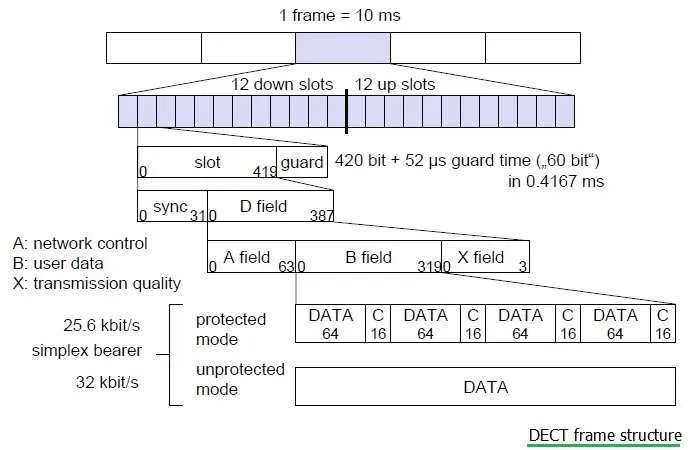
DECT NR+ uses 10 ms frame which is further subdivided into discrete “slots” and “subslots.” A single transmission can span up to 16 slots (lasting 6.6 ms) to send larger bursts of data. For more details on DECT frame, refer Legacy DECT Tutorial.
DECT NR+ PHY frame features a highly flexible “scalable numerology.” Controlled by a scaling factor (), the spacing between individual OFDM subcarriers can be dynamically set to 27 kHz, 54 kHz, 108 kHz or 216 kHz. By adjusting the Fast Fourier Transform (FFT) scaling factor (), the PHY layer can scale its transmission bandwidth to fit the application. The smallest nominal bandwidth is 1.728 MHz but it can mathematically scale up to 221.184 MHz.
Physical Channels within the Frame
Within a single transmission packet, the PHY layer separates the data into two distinct physical channels that are multiplexed together:
-
Physical Control Channel (PCC): This carries the vital control information, telling the receiving device how the data is formatted, what modulation is being used and the spatial streams involved.
-
Physical Data Channel (PDC): This carries the actual payload (the MAC Protocol Data Units or MAC PDUs) and higher layer application data.
DECT NR+ Network Architecture
DECT-2020 NR supports multiple network topologies, including Point to Point (P2P), Point to Multipoint (P2M), and Star (cellular like) networks. However, its standout feature is a self organizing, decentralized mesh network topology.
- Autonomous: The network self forms and self heals without the need for a central coordinator.
- Routing: Every device (node) in the network is capable of autonomously making local decisions to route data, allowing for massive scalability and strong resilience against interference or device mobility.
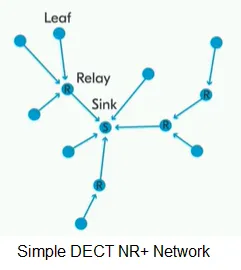
In the ETSI specifications, devices are referred to as Radio Devices (RD) operating in either FT (Fixed Termination) mode (acting as a router) or PT (Portable Termination) mode (acting as an endpoint). To make this easier to understand, the network consists of three functional node roles as follows.
-
Sink Node (Gateway / Border Router): This is a device operating in FT mode that has a direct physical connection to the backend internet or external network (e.g. via Ethernet or cellular backhaul). It acts as the root of the mesh tree.
-
Relay Node (Router): This device operates in both FT and PT modes simultaneously. It acts as a “child” to a node closer to the Sink and a “parent” to devices further away. It receives data from its children and routes it upstream, extending the physical range of the network.
-
Leaf Node (Child): Operating strictly in PT mode, this is a standard endpoint device (like a basic temperature sensor). It connects to Relay or Sink but does not forward traffic for other devices. This mode is often used for ultra low power, battery operated devices.
DECT NR+ Protocol Architecture
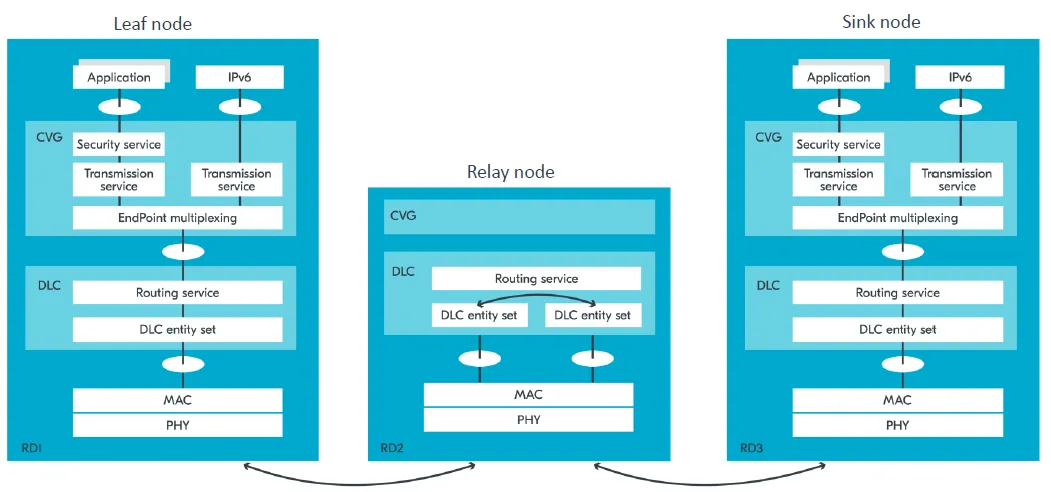
DECT NR+ is completely application-agnostic, meaning it can carry standard IP traffic (IPv6, TCP, UDP) or industrial protocols (OPC-UA, DLMS). This flexibility is handled by a streamlined 4-layer protocol stack as shown below.
1. Physical (PHY) Layer
The PHY layer is the foundation of the radio transmission. Instead of the older legacy DECT radio, DECT NR+ utilizes modern 5G radio techniques. Key features used in physical layer are as follows.
-
CP-OFDM (Cyclic Prefix Orthogonal Frequency Division Multiplexing): Allows for high data rates and robust performance in environments with heavy signal reflections (multipath fading).
-
HARQ (Hybrid Automatic Repeat Request): If a receiver fails to decode a packet, it stores the corrupted data and asks for a retransmission. It then combines the old and new signals (soft combining) to successfully decode the message, drastically improving reliability.
-
Modulation & Bandwidth: Supports sub-carrier spacing from 27 kHz to 216 kHz, and channel bandwidths from 1.728 MHz up to 221 MHz, enabling speeds from 1 Mbps up to 1.3 Gbps. PHY supports adaptive modulation schemes from BPSK to QPSK as well as 16-QAM, 64-QAM, 256-QAM and 1024-QAM based on range and data rate requirements.
2. Medium Access Control (MAC) Layer
The MAC layer handles radio resource control and ensures devices do not talk over one another.
-
Beaconing: Relay and Sink nodes periodically broadcast “Beacons.” These beacons dictate the network timing, allocate transmit times for leaf nodes and advertise routing costs.
-
Before Talk (LBT): Devices polite scan the frequency before transmitting. If the channel is busy, they use an exponential back-off timer to prevent data collisions, ensuring smooth co-existence with other wireless systems.
- The 32-bit Network ID ensures devices connect to the correct mesh. Once a device finds the correct network, it needs a unique identity to send and receive data. To save bandwidth and battery power over the airwaves, DECT NR+ splits device identification into two parts: a 32-bit “Long” ID for permanent routing and a 16-bit “Short” ID for quick, over the air radio transmissions.
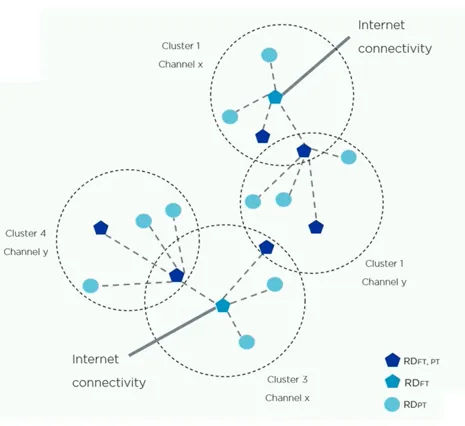
All the nodes in DECT NR+ are known as radio devices (RDs). These Radio Devices (RD) operate in either FT mode or PT mode as explained. The MAC layer diagram depicts network of nodes grouped into difference clusters and are assigned unique frequency bands to avoid interference.
3. Data Link Control (DLC) Layer
The DLC layer functions as brain of the mesh network. It handles routing and segmentation.
-
Uplink Routing: Devices dynamically calculate a “Routing Cost” to reach the Sink node based on signal strength, hop count and node load. Data is passed from child to parent until it reaches the internet.
-
Downlink Routing: When the Sink needs to send data to a specific node, the DLC layer uses directed forwarding (or hop-limited flooding) to send the packet down the exact branch of the mesh tree where the target device lives.
-
Segmentation: If an application packet is too large for the radio layer, the DLC segments it into smaller pieces and reassembles it at the destination.
4. Convergence (CVG) Layer
The Convergence layer sits at the top and acts as the adapter between the radio stack and the software application. Application Multiplexing: It allows multiple different applications to run over the same network simultaneously. Using “Endpoint values,” it identifies data types for instance, keeping IPv6 traffic separate from specific vendor specific sensor data.
DECT NR+ Security Layer
Security in massive IoT is critical. DECT NR+ takes a “Zero Trust” approach by enforcing two independent layers of security, ensuring that even if one layer is compromised, the data remains safe.
-
MAC Layer Security (Link to Link): Every single transmission between two direct nodes (including network beacons) is encrypted and authenticated. It utilizes AES-128 CTR for encryption (so eavesdroppers cannot read the data) and CMAC for integrity (so attackers cannot tamper with the data).
-
CVG Layer Security (End to End): Even though relay nodes pass data along the mesh, they cannot see the underlying payload. The CVG layer encrypts the data at the original source (e.g. the leaf sensor) and it is only decrypted at the final destination (the Sink or backend server).
Secure Joining: DECT NR+ supports SIM free authentication. Devices join the network via a secure provisioning proxy, exchanging cryptographic certificates before they are allowed to send or route user data.
DECT NR+ Use Case : Smart Energy Metering
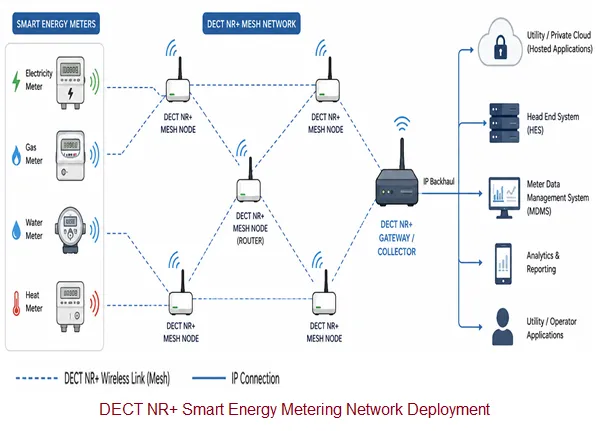
There are many applications of DECT NR+. We will explore Smart Electricity Metering (Advanced Metering Infrastructure - AMI) use case of DECT NR+.
-
Scenario : Utility companies need to connect millions of electricity meters across a city to monitor grid stability, track energy usage, and optimize renewable energy distribution.
-
Challenge : Cellular requires expensive monthly data plans for millions of meters and struggles to reach meters installed deep in concrete basements. Moreover, Power Line Communication (PLC) suffers from low data rates and noise.
-
Solution by DECT NR+ : With DECT NR+, the utility company deploys smart meters embedded with a DECT NR+ radio chip.
-
Self-Forming Mesh: The meters automatically find each other. A meter buried in a concrete basement (Leaf Node) cannot reach the cellular gateway on the roof. However, it can connect to a meter on the first floor (Relay Node), which connects to a meter on the third floor, which finally routes the data to the roof mounted Sink Node.
-
Self-Healing: If a relay meter breaks or is taken offline for maintenance, the basement meter instantly detects a new routing path via a different neighboring meter. No technician needs to visit the site to reconfigure the network.
-
High Data Rates & Low Latency: Unlike older IoT tech (e.g. LoRaWAN), DECT NR+ can push over 1 Mbps. This allows the utility not just to collect daily billing data, but to perform real time grid balancing and push over the air (OTA) firmware updates to thousands of meters simultaneously.
-
Zero OPEX: Because DECT NR+ operates in the globally available, license free 1.9 GHz band, the utility owns the network entirely. There are no monthly telecom subscription fees.
-
Benefits or Advantages of DECT NR+
- Self-Healing: The autonomous mesh network instantly detects power losses or blocked signals and automatically recalculates routing costs. Devices instantly connect to neighboring nodes, ensuring continuous network uptime with zero manual IT intervention.
- Decentralized: Unlike cellular 5G which relies on massive central base stations, DECT NR+ pushes intelligence to the edge. Every single radio device acts autonomously, making local decisions on frequency, transmission power and routing without a central coordinator.
- License-Exempt: Operating primarily in the dedicated 1.9 GHz DECT band, this standard allows enterprises to build private 5G networks completely free of spectrum licensing costs. You own the infrastructure outright, eliminating the need for SIM cards and monthly operator fees.
- Global Spectrum: Manufacturers can build a single global hardware SKU, as the radios automatically adjust to regional 1.9 GHz variations (1880 to 1900 MHz in Europe, 1920 to 1930 MHz in the US, and 1893 to 1906 MHz in Japan), alongside standard 2.4/5 GHz ISM bands. For complete guide to bands across the world, refer DECT NR Global Frequency Allocation.
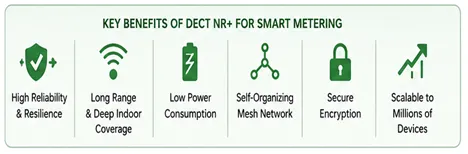
- Ultra-Low Latency: Natively supporting 5G URLLC requirements, DECT NR+ achieves an average one way latency of under 1 millisecond (< 1 ms) in Star and Point to Point topologies. This speed is driven by fast RX to TX transitions and rapid HARQ error correction.
- Highly Scalable: Built for massive IoT (mMTC), the clustered-tree mesh topology scales infinitely to support millions of nodes. “Listen Before Talk” (LBT) spectrum access ensures thousands of densely packed devices can operate in the same area without signal collisions.
- Low Cost of Ownership: CAPEX and OPEX are drastically reduced because the end devices act as the routing infrastructure, eliminating the need for expensive base stations or fiber backhauls. Additionally, deep sleep modes allow mesh routing nodes to operate on battery power for years.
- Scalable and Reliable: Even as the network scales to thousands of devices, DECT NR+ maintains 99.99% reliability. It uses modern cellular 5G techniques like CP-OFDM modulation, Turbo channel coding and HARQ soft combining to push data through noisy industrial environments.
Summary
DECT NR+ is ideal for industrial and commercial wireless networks. It solves the coverage, cost and scalability issues of traditional wireless networks by combining the gigabit capable, low latency radio technology of 5G with a decentralized, self-healing mesh architecture. Whether you are building a smart city grid, automating a massive warehouse, or deploying millions of IoT sensors, DECT NR+ provides a future proof, subscription free protocol stack to make it happen.
References : ETSI DECT-2020 New Radio (NR) Standards
- Overview - ETSI TS 103 636-1 (Part 1: Overview; Release 2)
- Radio requirements - ETSI TS 103 636-2 (Part 2: Radio reception and transmission requirements; Release 2)
- PHY - ETSI TS 103 636-3 (Part 3: Physical layer; Release 2)
- MAC - ETSI TS 103 636-4 (Part 4: MAC layer; Release 2)
- DLC and CVG - ETSI TS 103 636-5 (Part 5: DLC and Convergence layers; Release 2)