
DECT 6.0 vs CAT-iq vs DECT NR+: Key Differences
Advertisement
DECT 6.0 vs CAT-iq vs DECT NR+ highlights the evolution of DECT technology from conventional cordless telephony to advanced IP based voice services and modern 5G wireless connectivity. DECT 6.0 is the North American implementation of traditional DECT technology, mainly used for cordless phones and voice communication, while CAT-iq extends DECT for IP-based services, wideband/HD voice, and enhanced interoperability. In contrast, DECT NR+ (DECT 2020 New Radio) is a new generation, non-cellular 5G radio technology designed for industrial IoT, professional audio, automation, massive device connectivity, and ultra-reliable low latency communication.
DECT 6.0: The North American Cordless Standard
In the early 2000s, cordless phones in the US and Canada operated on 2.4 GHz and 5.8 GHz frequencies, which were highly prone to interference from Wi-Fi routers, Bluetooth devices, and microwaves.
When the US FCC opened up the 1.9 GHz band (specifically 1920–1930 MHz) for unlicensed voice communication, manufacturers brought the European “Classic DECT” standard to America. To distinguish these new, interference-free 1.9 GHz phones from older models, they branded them as “DECT 6.0.”
-
Primary Use: Traditional home and office cordless landline telephones.
-
How it works: It uses a simple “star” topology where a single base station (plugged into a wall telephone jack) connects wirelessly to one or more handsets.
CAT-iq: The IP & HD Voice Upgrade
CAT-iq stands for Cordless Advanced Technology – internet and quality. Introduced by the DECT Forum as the world transitioned from traditional analog telephone lines to VoIP (Voice over IP) broadband, CAT-iq was an enhancement profile built on top of the Classic DECT standard.
CAT-iq bridged the gap between DECT and the internet. It allowed broadband home internet routers to act as the DECT base station, meaning users could make VoIP calls without needing a traditional phone jack.
-
Primary Use: VoIP home telephony, HD Voice, and early Smart Home integration.
-
How it works: It still uses the traditional DECT “star” topology and physical radio layer, but it introduced wideband audio codecs for “HD Voice” (making calls sound much clearer) and basic data profiles to support simple smart home sensors (like door contacts or smart plugs).
DECT NR+: The Non-Cellular 5G Revolution
DECT NR+ (officially DECT-2020 NR) is a complete departure from traditional DECT. Developed by ETSI and recognized by the ITU-R as an official IMT-2020 (5G) technology, it is a brand-new, non-cellular 5G radio standard.
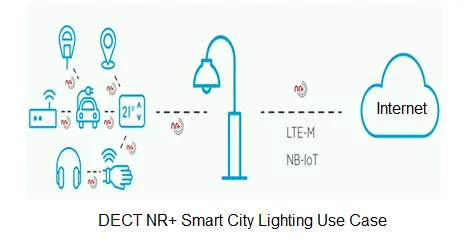
Unlike DECT 6.0 and CAT-iq, which were built primarily for voice and simple data, DECT NR+ was engineered for modern Industrial IoT era. It completely replaces the old physical radio layer with modern 5G radio techniques (CP-OFDM modulation).
Primary Use: Massive IoT (e.g. smart city metering or smart lighting in mesh topology), industrial automation, robotics, and ultra-reliable low-latency enterprise applications.
How it works: It utilizes a self organizing, autonomous mesh network. Devices don’t need a central base station; they connect to each other, passing data seamlessly across vast areas. It scales from 1 Mbps up to gigabit speeds, supporting millions of devices with sub-millisecond latency.
Comparison: DECT 6.0 vs. CAT-iq vs. DECT NR+
| Feature | DECT 6.0 | CAT-iq | DECT NR+ (DECT-2020 NR) |
|---|---|---|---|
| What is it? | A marketing term for Classic DECT adapted for North America. | An advanced profile for Classic DECT to support IP and broadband. | A radically new, non-cellular 5G standard for IoT and automation. |
| Technology Era | Legacy Voice (Pre-3G era tech) | Broadband / VoIP era | 5G (IMT-2020) |
| Primary Focus | Standard cordless voice calls (Analog/PSTN). | VoIP calls, HD Voice, and basic smart home sensors. | Massive IoT, ultra-low latency data, robotics, professional audio. |
| Network Topology | Star (Base station to handsets). | Star (Internet Gateway/Router to handsets/sensors). | Autonomous Mesh (Nodes route data to other nodes) & Star. |
| Physical Radio Layer | TDMA / FDMA (Legacy DECT) | TDMA / FDMA (Legacy DECT) | CP-OFDM & HARQ (Modern 5G cellular-style radio). |
| Data Rates | Very low (~32 kbps, optimized purely for standard voice). | Low/Moderate (Up to ~500 kbps for wideband audio & sensor data). | Extremely High (1 Mbps scaling up to 1.3 Gbps). |
| Spectrum / Frequency | 1.9 GHz (Specifically 1920-1930 MHz in North America). | 1.9 GHz (1880-1900 MHz in Europe, 1920-1930 MHz in US). | Sub-6 GHz Agnostic: Uses 1.9 GHz DECT bands, 2.4/5 GHz ISM, and custom TDD bands. |
| Base Station Requirement | Requires a dedicated DECT base station plugged into a phone line. | Often integrated directly into home Wi-Fi/Broadband routers. | No central base station required. Devices form their own network autonomously. |
Summary
- DECT 6.0 is the standard cordless phone technology found in North American homes and offices. CAT-iq is the upgraded version of DECT 6.0 technology, designed to connect those cordless phones to the internet for high definition VoIP calls. DECT NR+ is a complete reinvention of the technology for the 5G era, moving beyond consumer voice to deliver high speed, mesh networked data for massive industrial and commercial IoT applications.