
Legacy DECT vs DECT NR+: Key Differences Explained
Advertisement
Legacy DECT and DECT NR+ are wireless technologies designed for different generations of applications. Legacy DECT (Digital Enhanced Cordless Telecommunications) is primarily optimized for cordless voice, enterprise telephony and established low latency applications. DECT NR+ (DECT-2020 New Radio) introduces a redesigned, OFDM based radio interface aimed at industrial IoT, massive device connectivity, ultra-reliable low latency communication and flexible mesh networking.
What is Legacy DECT?
Legacy DECT (Digital Enhanced Cordless Telecommunications) is a highly successful wireless standard originally designed in the 1990s primarily for voice communications. It is often referred to as Classic DECT. It is the technology that powers billions of cordless landline phones used in homes and offices worldwide. Over time, it evolved to include data transmission and introduced DECT ULE (Ultra Low Energy) to support basic smart home and IoT applications. Figure depicts legacy DECT phone network used in earlier days.
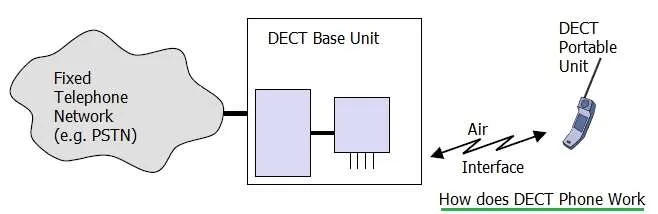
Legacy DECT traditionally operates in a “star” network topology, where a central base station (Fixed Part) connects directly to multiple portable devices (Portable Parts). It operates on a fixed channel bandwidth of 1.728 MHz and utilizes a dedicated, license exempt frequency band (such as 1880 to 1900 MHz in Europe), which has historically shielded it from the heavy interference seen in Wi-Fi and Bluetooth bands. For more details refer Legacy DECT Tutorial.
What is DECT NR+ (DECT-2020 NR)?
DECT NR+ is a completely new technology developed by ETSI. While it shares the “DECT” name and can operate in the same protected frequency bands, it is an entirely independent radio standard. Crucially, DECT NR+ is officially recognized by the ITU-R as a 5G technology (IMT-2020) making it the world’s first non-cellular 5G standard.
It introduces advanced radio technologies used in cellular 5G such as CP-OFDM modulation, Turbo coding and Hybrid ARQ. It utilizes these features in its physical and MAC layers and can help in implementation of private, license free networks.
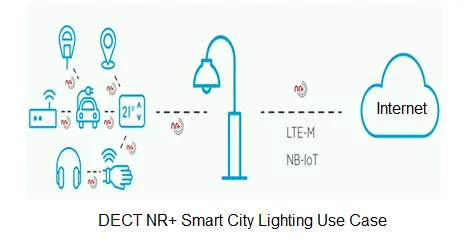
Its standout feature is its autonomous mesh topology, allowing devices to act as routers and pass data seamlessly across vast areas without central coordination. It scales to support massive IoT (mMTC) with millions of nodes, while also delivering ultra-reliable, sub-millisecond latency (URLLC) for robotics, professional audio and industrial automation. One of the use case of DECT NR+ technology is smart lighting used in smart city deployment among other features.
Legacy DECT vs. DECT NR+: Key Differences
| Feature / Capability | Legacy DECT (Classic & ULE) | DECT NR+ (DECT-2020 NR) |
|---|---|---|
| Technology Generation | Pre-3G / Evolved IoT (ULE) | 5G (Recognized under IMT-2020) |
| Network Topology | Star topology (Base station to portable devices) | Point-to-point, Star, and Autonomous Mesh (Clustered tree) |
| Primary Use Cases | Cordless telephony, voice, basic smart home sensors, audio streaming. | Massive IoT (smart metering), industrial automation, robotics, high-density networks, ultra-low latency audio. |
| Physical Layer (PHY) | FDMA/TDMA (Frequency/Time Division Multiple Access) | CP-OFDM with TDMA/FDMA, Turbo channel coding, and HARQ (Hybrid ARQ) for fast error correction. |
| Channel Bandwidth | Fixed at 1.728 MHz | Highly scalable: 1.728 MHz up to 221.184 MHz |
| Data Rates | Low to moderate (typically under 1 Mbps for standard DECT) | Highly scalable: 1 Mbps up to 1.3 Gbps (with wideband and modulation up to 1024-QAM) |
| Latency | Moderate (optimized for human voice, typically ~10ms+) | Ultra-low latency: < 1 ms in star topology; highly deterministic in mesh. |
| Frequency Spectrum | Primarily locked to the dedicated 1.9 GHz DECT bands. | Frequency-agnostic (sub-6 GHz): Uses 1.9 GHz DECT bands, global ISM bands (2.4 GHz, 5 GHz), and local licensed TDD bands. |
| Device Roles | Fixed roles: Base Station (Fixed Part) and Handset/Sensor (Portable Part). | Dynamic roles: Any device can autonomously switch between being a routing node (FT) or leaf node (PT). |
| Routing / Range | Limited to the direct RF range of the single base station. | Massive range extension via multi-hop mesh routing; data hops from device to device to reach the internet sink. |
Summary
Despite being a completely different technology, DECT NR+ was specifically designed to coexist with Legacy DECT. It aligns its smallest channel bandwidth (1.728 MHz), radio frame lengths and transmission slots with Classic DECT. By utilizing “polite spectrum access” (i.e. Listen Before Talk) and active power control, a DECT NR+ network can operate in the exact same physical space and frequency band as a Legacy DECT network without causing interference.