
What is V-Antenna: Advantages and Disadvantages
By RF Wireless Expert Team
Advertisement
A V-antenna is a directional wire antenna formed by two long conductors arranged in a V-shaped configuration to improve signal transmission and reception. Its advantages include high directivity and simple construction, while its disadvantages include large installation space requirements and limited performance outside its designed frequency range.
Key features and Types of V-Antenna
- The V-antenna is a type of long wire antenna.
- It is constructed by arranging a long wire in a V-shaped pattern.
- It consists of two beverage antennas separated by an angle and fed from a balanced line.
- It’s often used as a bi-directional resonant antenna.
- V-antennas typically operate in the high-frequency (HF) range, usually from 3 to 30 MHz.
- The antenna impedance is around 800 Ohms.
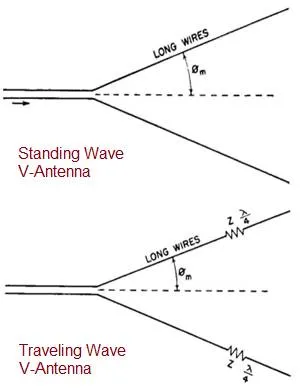
- Based on their construction, V-antennas can be categorized into the following types:
- Standing wave V-antenna
- Traveling wave V-antenna
- Double Traveling wave V-antenna
Benefits or Advantages of V-Antenna
- It has a simple construction.
- It offers high gain.
- It has a low manufacturing cost, making it less expensive overall.
- It offers higher bandwidth when the antenna is terminated.
Drawbacks or Disadvantages of V-Antenna
- Standing waves are formed due to its design.
- Strong minor lobes are generated.
- V-antennas are typically used for fixed-frequency installations.
- It offers lower efficiency.
- While it uses low supporting structures, it requires large areas for installation.
- Horizontal beamwidth and elevation point are not separately controlled; they are mutually dependent on the array geometry.
Summary
A V-antenna provides efficient long-distance directional communication through its simple design, making it suitable for HF applications despite its large physical size.
Continue Learning About Antenna Technology
- Antenna Basics Tutorial
- Antenna Related Terms
- Antenna mechanical Vs. electrical tilt
- Difference between antenna gain directivity efficiency
- Antenna gain & effective area
- Bandwidth Vs. beamwidth antenna difference
- Antenna Factor
- Near field Vs. Far field antenna radiation pattern
Explore Different Types of Antennas
-
Check-out: Guide to List of Antenna Types >>