
STOMP Protocol Architecture Basics for IoT
By RF Wireless Expert Team
Advertisement
This page covers the basics of the STOMP protocol architecture. STOMP, which stands for Simple Text Oriented Messaging Protocol, is a text-based protocol used with message-oriented middleware in the Internet of Things (IoT).
- STOMP is a text-based protocol.
- It’s designed to work with message-oriented middleware.
- It uses an interoperable wire format.
- This format allows clients to communicate with a message broker, enabling easy and widespread messaging interoperability. This communication is independent of the languages, platforms, and brokers used in the architecture.
- The STOMP protocol provides a message header with properties and a frame body, similar to AMQP.
- It’s simple and lightweight, with a wide range of language bindings, and provides some transactional semantics.
STOMP Architecture
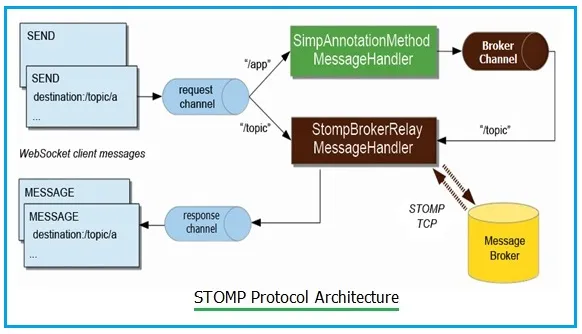
Figure: STOMP Architecture
Like other broker-based protocols, STOMP specifies a publish-subscribe mechanism. Clients subscribe to topics (similar to a path in HTTP) and receive notifications whenever messages are sent to that topic by the broker.
- STOMP doesn’t require the use of queues and topics. Instead, it uses the “SEND” semantic with a “destination” string.
- STOMP is a bi-directional protocol that uses textual headers similar to HTTP.
- The broker must map the “destination” string onto something it understands internally, such as a topic, queue, or exchange.
- Consumers subscribe to these destinations.
- Different brokers can support different flavors of destinations, as they aren’t mandatory in the specifications. Therefore, care should be taken when porting code between different brokers, as it’s not always straightforward.
EXAMPLE: Generic broker services like RabbitMQ or ActiveMQ use STOMP/AMQP protocols to ease and scale the deployment of modern cloud services. WebSockets help use queuing protocols (e.g., STOMP/AMQP) directly from web browsers.
Continue Learning IoT Protocols
- MQTT Architecture: Message Types, Format, Flow
- CoAP Protocol Architecture & Messages Exchanged between client & Server
- DDS Architecture & its protocol stack layers
- AMQP Architecture Components & Frames
- REST Protocol Vs. SoAP
- XMPP Protocol & Server-Client Interaction
- LWM2M : Key Advantages and Disadvantages
- 6LoWPAN Mesh Network & Protocol Stack
- RPL vs CORPL vs CARP: IoT Routing Protocol Comparison
- HTTP Vs. HTTPS : Key Comparison
- FTP Protocol Basics : key advantages & disadvantages
- Ping vs. Ping6: IPv4 and IPv6 Connectivity
- SFTP Vs. SCP : key Differences
- SSL Vs. SSH : Key Comparison
- MPTCP Protocol : Key Advantages & Disadvantages
- What is QUIC (Quick UDP Internet Connections)?
- TCP-IP Packet Format & its fields with example
Compare IoT Protocols
- MQTT Vs. DDS Protocol
- MQTT Vs. REST Protocol
- MQTT Vs. SMQTT
- CoAP Vs. MQTT : Key Differences
- CoAP Vs. HTTP : Comparison between them
- SFTP Vs. FTPS
- FTP Vs. HTTP : Key Differences between them
- FTP Vs. TFTP (Trivial File Transfer Protocol)
- FTP Vs. SMTP
- AMQP (Advanced Message Queuing Protocol) Vs. JMS(Java Message Service)
- TCP Vs. Multipath TCP (MPTCP)