
What is SAW Filter: Basics, Advantages and Disadvantages
Advertisement
A Surface Acoustic Wave (SAW) filter is an electronic component that uses acoustic waves traveling across a piezoelectric substrate to filter radio frequency signals. Its advantages include compact size and excellent frequency selectivity, whereas its disadvantages include limited power handling capability and reduced performance at very high frequencies.
SAW filter structure and selection guide
SAW stands for Surface Acoustic Wave. These filters are fabricated on wafers and allow electro-acoustic coupling via a transducer.
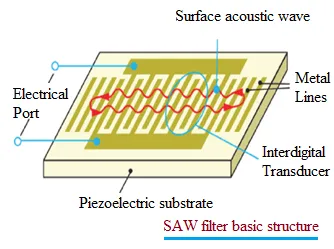
Figure-1 SAW filter structure
The figure depicts the basic structure of a SAW filter. As shown, it stores the signal in acoustic resonators, unlike conventional filters which store energy as charge on a capacitor and as current in an inductor. Surface Acoustic Waves propagate in a lateral direction.
The shape and center frequency of the passband are determined by Interdigital Transducer (IDT) parameters, namely the pitch, line width, and thickness. It is designed to operate up to frequencies of 2.5 GHz with optimum performance.
The following parameters are used in the selection of an appropriate SAW filter for your needs:
- Filter Bandwidth of operation
- Transition Bandwidth
- In-Band Ripple
- Out of Band Side Lobe Level
- Group Delay Variation Over Passband
- Insertion Loss
- Size and Package Type
Benefits or advantages of SAW Filters
- Offers low insertion loss (< 3 dB) at lower frequency ranges.
- Offers excellent rejection (>30 dB out of band) at lower frequency ranges.
- Covers a broad bandwidth (<100 MHz).
- Due to their fabrication on wafers, they can be produced in large volumes at low cost.
- Offers an ultra-small size (~9 mm2) for critical designs as components such as filters/duplexers of different bands can be integrated on a single chip with little or no additional fabrication steps.
- This filter structure supports flexible port configurations.
- The filter offers good temperature stability of about 3 ppm/°C.
- The velocity of SAW waves is 105 times less compared to EM wave velocity. SAW filter designs are used where EM wave designs are impractical to develop.
Limitations or disadvantages of SAW Filters
- Cannot be used for greater frequencies such as above 2.5 GHz and mmWave bands, as acoustic waves exhibit degradation in selectivity at frequencies >6 GHz.
- Handles lower RF power levels than BAW filters.
- Has more temperature variation than BAW devices.
Summary
SAW filters are widely used in wireless communication, television, GPS, and mobile devices because they provide accurate frequency filtering in compact designs. Their filtering advantages support reliable signal processing, although power limitations and operating frequency constraints influence application selection.
Continue Learning Filter Fundamentals & Terminology
- Lumped Element Filter : Key Advantages & Disadvantages
- Microstrip Based RF Low Pass Filter Design Example
- Understanding Filter Terms
- RF Filters : Types, Selection Guide, Advantages & Disadvantages
- Active vs Passive Filters
- Analog vs Digital Filters
- Butterworth, Chebyshev, Bessel, and Elliptic Filters
- FIR Filter vs IIR Filter
- Understanding CIC (Cascaded Integrator-Comb) Filters
- Pi Filter: Advantages & Disadvantages
- Active vs Passive Harmonic Filters