
What is FBAR Filter : Advantages and Disadvantages
Advertisement
A Film Bulk Acoustic Resonator (FBAR) filter is a high frequency RF filter used in smartphones, Wi-Fi devices, and wireless communication systems. It offers excellent selectivity and compact size for modern RF front end designs. Advantages include low insertion loss and high Q-factor, while disadvantages include manufacturing complexity and higher production costs.
Key features of FBAR Filter & its design
- FBAR stands for Film Bulk Acoustic Resonator.
- FBAR filters are created using thin film semiconductor processes.
- This process involves building a Metal Aluminum Nitride-Metal sandwich structure in the air.
- They are a type of BAW (Bulk Acoustic Wave) filter, known for superior performance compared to SAW (Surface Acoustic Wave) filters.
- FBAR technology is also used to create duplexers, multiplexers, resonators, and other related devices.
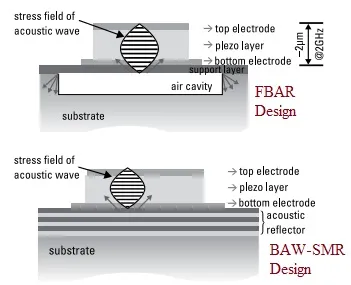
Figure 1: FBAR and BAW SMR Filter Designs
- Figure 1 illustrates the designs of FBAR (Film Bulk Acoustic Resonator) and BAW SMR (Bulk Acoustic Wave Solidly Mounted Resonator) filters.
- In FBAR filters, the air/crystal interface on both sides of the resonator ensures that the main mode of interest (acoustic energy) is properly contained.
- Figure 2 (not included here) demonstrates the attenuation versus frequency curve for both FBAR and SAW filters.
- For a comparison, refer to this article about the difference between BAW and SAW filters.
Advantages of FBAR Filters
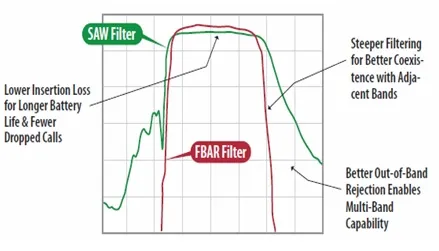
Figure 2: Advantages of FBAR Filters
Following are the key benefits of using FBAR filters:
- Lower Insertion Loss: This results in less current consumption, which translates to longer battery life and fewer dropped calls. This is a significant advantage in mobile devices.
- Steeper Filtering: FBAR filters provide sharper filtering characteristics, leading to better coexistence with adjacent frequency bands. This is important in crowded spectrum environments.
- Better Out-of-Band Rejection: They offer excellent rejection of signals outside the desired frequency band, enabling multi-band capability in devices. This means a single device can operate on multiple frequency bands without interference.
- Ultra-Small Size: FBAR filters are very compact, making them easy to integrate with other semiconductor chips in small devices.
- Reliable Performance: They operate reliably under high power conditions and in extreme temperatures.
Disadvantages of FBAR Filters
While FBAR filters offer many advantages, they also have some drawbacks or limitations :
- Thermal Management: The thermal path for heat generated within the device is critical in the design of both FBAR and BAW-SMR filters.
- In BAW-SMR designs, heat can be conducted into the substrate, allowing it to spread.
- However, FBAR filters have an air gap on each side of the resonator, making the thermal conduction path weaker. This means that FBAR designs require careful consideration of thermal management to prevent overheating.
Summary
FBAR filters provide high performance RF filtering in wireless communication devices. Advantages include compact size and excellent selectivity, while disadvantages include fabrication challenges and increased cost.
Continue Learning Filter Fundamentals & Terminology
- Lumped Element Filter : Key Advantages & Disadvantages
- Microstrip Based RF Low Pass Filter Design Example
- Understanding Filter Terms
- RF Filters : Types, Selection Guide, Advantages & Disadvantages
- Active vs Passive Filters
- Analog vs Digital Filters
- Butterworth, Chebyshev, Bessel, and Elliptic Filters
- FIR Filter vs IIR Filter
- Understanding CIC (Cascaded Integrator-Comb) Filters
- Pi Filter: Advantages & Disadvantages
- Active vs Passive Harmonic Filters