 RF
RFCavity Filter Types : 5 Advantages and Disadvantages
Advertisement
Introduction : These filters deliver high performance rf filtering using different types. It includes comb, interdigital, waveguide and dielectric cavity filters. The resonators used in its design deliver unrivaled high Q-factor, low insertion loss and exceptional power handling abilities. They are widely used in RF and Microwave systems such as base stations, satellite, radar and wireless communication requiring sharp frequency selectivity and lower loss at higher frequencies.
What is cavity filter?
It is a high frequency resonant filter built using one or more metallic cavities i.e. hollow enclosures used to confine electromagnetic (EM) waves. The key points about cavity filter are as follows.
- Cavity acts like resonator similar to LC circuit
- The filter passes or rejects signals based on resonant frequency determined by cavity dimensions, shape and tuning elements like screws or dielectric inserts etc.
- Commonly used at VHF, UHF, microwave or mmwave frequencies
Types of Cavity Filters
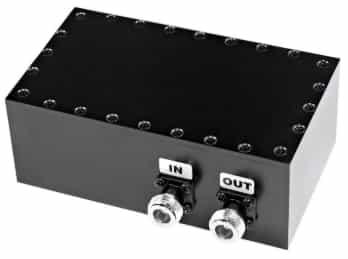
Following are different ways by which cavity filters are classified into different types. The figure depicts one such cavity filter with its input and output ports.
-
By its frequency response : Classified into band pass, band stop, low pass and high pass types.
-
By resonator structure : Classified into coaxial, waveguide, dielectric resonator and helical resonator cavity filters.
-
By coupling type : Classified into iris coupled cavity filter and probe/loop coupled cavity filter.
Advantages of Cavity Filter
Following are some of the benefits of cavity filters.
- Offers high selectivity
- Offers low insertion loss
- Offers high power handling capability
- Offers high Q factor
- Metal cavities designed with temperature compensated designs are more stable than LC circuits
- They are mechanically robust and reliable for long term use in outdoor applications.
Disadvantages of Cavity Filter
Following are some of the drawbacks of cavity filters.
- They are bulky and heavy compared to microstrip or SAW/BAW filters.
- They are expensive due to precision machining and tuning requirement during its manufacturing.
- Tuning is difficult due to manual adjustment of screws and rods as used in the design.
- Not suitable for smartphones or small IoT devices.
- Vibration or physical shock can detune cavities.
Conclusion: Cavity filters are essential for critical RF applications ranging from telecommunications to radar and satellite systems. Although physical size and production cost are higher compared to alternatives; these rf components offer elite selectivity, robust performance and handle high power.
Advertisement


