
What is an RF Jammer: Advantages and Disadvantages
Advertisement
An RF jammer is an electronic device that intentionally transmits radio frequency signals to disrupt or block wireless communication within a specific frequency range. Its advantages include controlled signal denial in authorized environments, whereas its disadvantages include communication interference, legal restrictions, and potential disruption of legitimate wireless services.
RF Jammer Working operation and selection criteria
An RF jammer is a device designed to block or disrupt wireless communications by transmitting signals that interfere with other wireless systems.
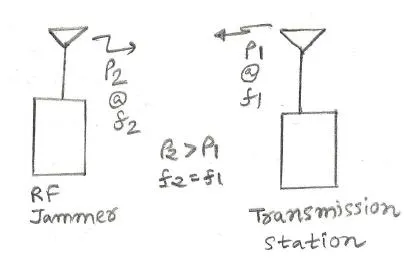
The figure-1 below illustrates an RF jammer effectively blocking signals from a transmission station.
 RF Jammer
As shown, the RF jammer operates on the same frequency band and uses similar modulation techniques as the transmission station it’s intended to jam. To achieve the desired effect, the RF jammer’s power output is typically higher than that of the transmission station.
Key Specifications of RF Jammers
- Frequency Range: The range of frequencies the jammer is capable of blocking.
- Output Power: The power output of the jammer, which determines its effectiveness in blocking or attenuating RF signals.
- Coverage Area/Range: The geographical area within which the jammer’s output is effective.
- Selectivity: The ability of the jammer to target specific signal bands while leaving others unaffected.
- Legality: Ensuring the RF jammer is legal to use in the specific region and doesn’t block emergency communications or other critical systems.
- Other Features: Portability, durability, affordability, and ease of use are important considerations.
Benefits or Advantages of RF Jammers
- Enhanced Security: RF jammers can prevent unauthorized access to wireless devices, protecting sensitive information from being intercepted during wireless communications.
- Surveillance Prevention: They can block signals from wireless cameras and other monitoring devices, preventing unwanted surveillance.
- Military and Defense Applications: RF jammers are commonly used in military applications to disrupt enemy communication systems and prevent the use of remote-controlled explosives.
Drawbacks or Disadvantages of RF Jammers
- Limited Legal Use: RF jammers are primarily restricted to military, government agencies, or research purposes.
- Legality Issues: In most countries, using an RF jammer without proper authorization is illegal and can result in fines.
- Potential Interference: RF jammers can unintentionally interfere with emergency communications, legitimate cellular networks, GPS navigation, and wireless medical devices.
- Limited Coverage: The coverage area of an RF jammer is limited by its design, making it ineffective against targets outside its range.
- Technology-Specific: RF jammers are designed to jam specific frequency ranges and wireless technologies, limiting their versatility.
Summary
RF jammers are used in specialized authorized applications where controlled wireless signal suppression is required for security or testing purposes. Their operational advantages are limited to regulated environments, while legal compliance, interference risks, and potential impact on essential communication systems remain significant considerations.
Explore RF Use Cases (Applications)
- RF Energy Harvesting
- RF Fingerprinting Positioning Method
- RF Ablation : Key Benefits & Risk Concerns
- RF Chemotherapy : Principles, Benefits & Drawbacks
- RF Skin Tightening for Facial Treatment : Benefits & Safety Guidelines
- RF Frequency Jamming Techniques
- RF Capture Technology Basics
- RF Cooking : Working Principle, Benefits & Drawbacks
- RF Spectroscopy: Working, Applications & Manufacturers
- RF Sputtering : Key Advantages & Disadvantages
- RF Welding Procedure : Advantages & Disadvantages
- RF Heating Procedure & Mechanism : Benefits & Drawbacks
- RF Defrosting : Key Advantages & Disadvantages
- What is RF Sensing : Key benefits and limitations