
What is RF Cooking: Advantages and Disadvantages
Advertisement
RF cooking is a food processing technology that uses radio frequency electromagnetic energy to heat food rapidly and uniformly throughout its volume. Its advantages include faster cooking and improved heating consistency, whereas its disadvantages include higher equipment costs, complex power control, and limited adoption in conventional household kitchens.
Working principle of RF cooking using RF heating technique
RF cooking refers to the process of using radio frequencies to heat food. RF heating has found various applications within the food industry, including:
- Drying
- Baking
- Thawing
- Pasteurization
- Heating of bread
- Sterilization
- Meat processing
- General cooking
Radio frequencies occupy the lower portion of the electromagnetic spectrum, typically ranging from 1 to 300 MHz. For food heating, frequencies between 10 and 15 MHz are commonly used. At 27.12 MHz, RF energy can achieve a penetration depth of approximately 20 cm during heating. Dielectric RF heating generally utilizes a frequency band from 13 MHz to 6 GHz. The FDA (Food and Drug Administration) has approved the use of 915MHz and 2450 MHz for food cooking applications.
The optimal cooking time varies depending on the food product, frequency used, shape and size of the food, and other relevant parameters.
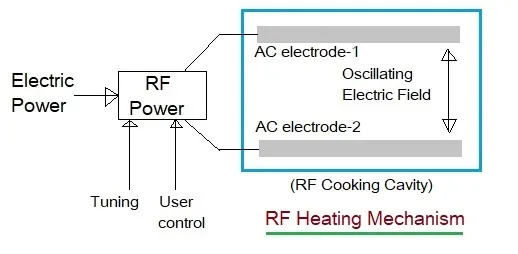
RF energy is generated using RF transistors and amplified using solid-state amplifiers. This RF energy serves as a replacement for the magnetrons traditionally used in microwave ovens. RF energy can be produced using semiconductor devices like oscillators and mixers, along with multiple antennas to meet the requirements of microwave ovens. RF couplers are implemented in microwave ovens to provide closed-loop feedback, and humidity sensors are often incorporated inside the cavity for additional feedback control.
The table below outlines frequencies used in RF heating for various food items and processes:
| Frequencies | Food items | Process |
|---|---|---|
| 14 to 17 MHz | Egg, Fruits, Vegetables | Thawing of frozen food |
| 36 to 40 MHz | Fish and Meat | Thawing of frozen food |
| 27.12 MHz | Cookies, Crackers etc. | Post baking drying |
| 60 MHz | Cocoa beans | Roasting |
| 9 MHz | Meat | Pasteurization |
Advantages of RF Cooking
The following are the key benefits of RF Cooking over conventional heating and drying techniques:
- Avoids Overheating: It prevents overheating of the surface of the food product, ensuring more even cooking.
- Deep Penetration: It offers deep penetration and contactless heating of food, leading to faster and more efficient cooking.
- Faster Heating: Devices like microwave ovens that use RF energy provide rapid heating, reducing cooking time.
- Energy Efficiency: RF energy-based ovens are energy efficient and can lead to electricity savings.
- Improved Food Quality: RF cooking results in tasty and hygienically cooked food.
Disadvantages of RF Cooking
The following are the main drawbacks of RF Cooking:
- Higher Cost: Cooking devices that utilize RF energy are generally more expensive compared to ohmic heating devices.
- Variable Cooking Times: Different food products require different cooking times, requiring the user to be skilled in setting the timer accordingly to achieve optimal results.
Summary
RF cooking offers an innovative approach to food processing by improving heating uniformity, reducing cooking time, and enhancing product quality. Its technological advantages make it attractive for commercial food production, although equipment investment, process optimization, and operational complexity remain important considerations for widespread adoption.
Explore RF Use Cases (Applications)
- RF Energy Harvesting
- RF Fingerprinting Positioning Method
- RF Ablation : Key Benefits & Risk Concerns
- RF Chemotherapy : Principles, Benefits & Drawbacks
- RF Skin Tightening for Facial Treatment : Benefits & Safety Guidelines
- RF Frequency Jamming Techniques
- RF Capture Technology Basics
- RF Spectroscopy: Working, Applications & Manufacturers
- RF Sputtering : Key Advantages & Disadvantages
- RF Welding Procedure : Advantages & Disadvantages
- RF Heating Procedure & Mechanism : Benefits & Drawbacks
- RF Defrosting : Key Advantages & Disadvantages
- What is RF Sensing : Key benefits and limitations