
Wireless Surveillance System Explained
Advertisement
Surveillance isn’t just about RF and wireless technologies. It encompasses anything related to the security of people or possessions. Both software and hardware tools exist for wired and wireless security applications.
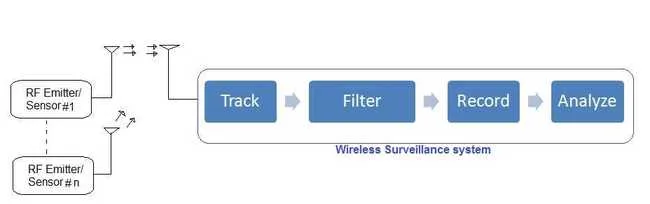
RF surveillance is the technique of detecting and locating illegal or suspicious radio frequency transmissions. A wireless solution for this is called a wireless surveillance system. The process is illustrated below.
How It Works
The core modules within a wireless surveillance system are tracking, filtering, recording, and analyzing.
Think of the wireless surveillance system as the receiver. In the first step, it scans and selects the frequency band, then identifies signals. Next, it filters out the signal of interest based on factors like modulation detection, threshold levels, and alarm conditions. Finally, it demodulates, decodes, records, and analyzes the received signals.
The area being monitored has RF emitters or sensors strategically placed. These sensors transmit signals at various frequencies, based on standards and technologies like WLAN, Zigbee, WiMAX, or cellular technologies (GSM, CDMA, LTE, etc.).
Therefore, the wireless surveillance system needs to support the frequencies used by the sensors in the area under surveillance.
Applications
Wireless surveillance systems have many applications, playing a critical role in RF surveillance. Some examples include:
- Spectrum regulators
- Public Safety Agencies
- Border security force
- Coastal security
- Military
Continue Learning Wireless Fundamentals & Core Concepts
- Wireless Communication Basics : Key Advantages & Disadvantages
- FDD vs TDD Difference in Wireless Communication
- FDMA Vs. TDMA Vs. CDMA : Key Differences
- Fading Basics and Types in Wireless Communication
- Interference Basics & Types
- Listen Before Talk Wireless Communication
- Wireless Propagation Modes
- Wireless Channel Models
- Wired Vs. Wireless Communication : Key Differences
Innovative Wireless Applications & Use Cases
- Top 10 Applications of Wireless Technology
- Wireless Charging standards : Qi & NFC
- Wireless Electricity Transmission Basics
- Medical Telemetry & RF Wireless Technologies
- V2V vs V2I: Vehicular Wireless Communication
- Wireless Cloud Surveillance Systems
- Underwater Wireless Communication Systems
- Optical Wireless Network Communication
- Satellite & Mobile Communication : Key differences