
What is RF Spectroscopy: Working, Applications & Manufacturers
Advertisement
RF spectroscopy is an advanced analytical technique that measures the interaction between radio frequency electromagnetic fields and physical matter. The working principle involves exposing a sample to RF waves and observing resonant frequency absorption, widely known in Nuclear Magnetic Resonance (NMR). Primary applications include chemical analysis, material science, and medical MRI, supported by top manufacturers like Bruker.
RF Spectroscopy working procedure
RF spectroscopy is a technique that uses radio frequencies to analyze materials at a molecular level. The figure below depicts a typical waveform captured using an RF spectroscopy instrument. The process relies on subjecting tissue to an electric field (E-field). The instrument measures the response of the E-field to produce an electromagnetic (EM) signature. This helps to differentiate between normal and malignant tissues, making it useful for detecting cancerous areas.
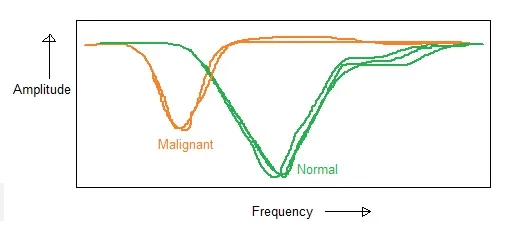 RF spectroscopy
There are various other spectroscopic techniques, including:
- Vibrational Spectroscopy (IR and Raman)
- UV-vis spectroscopy
- Nuclear Magnetic Resonance (NMR)
- Electron Spin Resonance (ESR)
- X-ray spectroscopy
- Electron spectroscopy
- Mössbauer spectroscopy
- Mass spectroscopy
- Thermal analysis
Spectroscopic techniques, including RF spectroscopy, operate on the principle that materials emit or absorb electromagnetic (EM) energy under specific conditions. These techniques operate over different, and often limited, radio frequency ranges, depending on various processes and amplitudes. RF spectroscopy specifically operates on radio frequency signals.
RF Spectroscopy Manufacturers
- MarginProbe system from Dube Medical Devices
- Siemens
- Bruker Corporation
- Oxford Instruments
- Keysight Technologies (formerly Agilent Technologies)
- JEOL Ltd.
Applications of RF Spectroscopy
RF spectroscopy is a powerful analytical tool with diverse applications, stemming from its ability to detect and analyze materials based on their interactions with radiofrequency waves. Here’s a deeper look at some key areas:
-
Material Characterization:
- Identifies chemical and physical properties of materials, such as dielectric constants and molecular structures.
- Used extensively in research and development for polymers, composites, and ceramics.
-
Nondestructive Testing (NDT):
- Evaluates the structural integrity of materials without causing damage.
- Commonly used in aerospace, automotive, and construction industries to ensure safety and reliability.
-
Biomedical Applications:
- Analyzes biological tissues to study hydration levels, ion content, and cell structures.
- Used in diagnosing diseases, cancer detection, and monitoring treatment responses.
-
Food and Agriculture:
- Detects moisture content, fat composition, and ripeness in food products, ensuring quality and consistency.
- Assesses soil properties and quality for better crop management, improving agricultural yields.
-
Pharmaceutical Industry:
- Ensures the quality and uniformity of tablets, capsules, and powders.
- Aids in identifying counterfeit drugs, safeguarding public health.
-
Environmental Monitoring:
- Measures pollution levels and contaminants in water, air, and soil.
- Useful for detecting hazardous chemicals or radiation levels in the environment, promoting environmental safety.
-
Communication Technology:
- Evaluates materials used in RF devices such as antennas and circuit boards.
- Ensures optimal performance in telecommunication systems, improving connectivity and signal strength.
-
Astronomy and Space Research:
- Detects and analyzes cosmic radio waves emitted by celestial objects.
- Helps study planetary atmospheres, interstellar media, and galaxies, expanding our understanding of the universe.
-
Forensics:
- Identifies unknown substances in criminal investigations.
- Detects drugs, explosives, and other hazardous materials, assisting law enforcement.
-
Industrial Applications:
- Ensures quality control in manufacturing processes across various sectors.
- Used in electronics for testing semiconductors and integrated circuits, maintaining product standards.
Summary
RF spectroscopy remains an invaluable analytical tool for non-destructive molecular testing and high precision chemical structure identification. Its widespread applications in material science and medical diagnostics make it indispensable for modern scientific research and quality control.
Explore RF Use Cases (Applications)
- RF Energy Harvesting
- RF Fingerprinting Positioning Method
- RF Ablation : Key Benefits & Risk Concerns
- RF Chemotherapy : Principles, Benefits & Drawbacks
- RF Skin Tightening for Facial Treatment : Benefits & Safety Guidelines
- RF Frequency Jamming Techniques
- RF Capture Technology Basics
- RF Cooking : Working Principle, Benefits & Drawbacks
- RF Sputtering : Key Advantages & Disadvantages
- RF Welding Procedure : Advantages & Disadvantages
- RF Heating Procedure & Mechanism : Benefits & Drawbacks
- RF Defrosting : Key Advantages & Disadvantages
- What is RF Sensing : Key benefits and limitations