
What is MTI Radar : Advantages and Disadvantages
Advertisement
MTI (Moving Target Indicator) radar is a radar system designed to distinguish moving targets from stationary objects by analyzing Doppler frequency shifts. It improves target detection in cluttered environments and is widely used in defense and surveillance. Limitations include blind speeds, processing complexity, and sensitivity to environmental conditions.
MTI Radar Block Diagram
MTI radar stands for Moving Target Indication Radar. It is a type of pulsed radar characterized by a very low Pulse Repetition Frequency (PRF). This low PRF ensures there is no range ambiguity in the MTI radar’s operation.
MTI radar is used primarily to determine the velocity of targets and to distinguish moving targets from stationary objects (clutter). The unambiguous range (Run) is expressed by the following equation:
Run = Vo / fp
Where:
- Vo = velocity of electromagnetic waves in free space
- fp = PRF
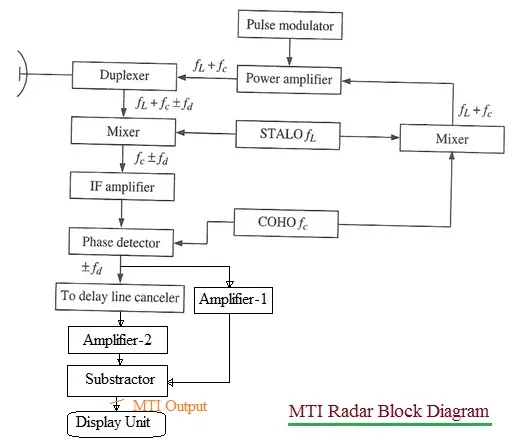 Image alt: MTI Radar Block Diagram
The radar leverages the Doppler effect in its operation. It effectively eliminates clutter from stationary objects, allowing it to identify moving targets. Figure 1 (above) depicts a block diagram of a typical MTI radar, which is largely self-explanatory. In the diagram, STALO refers to a Stable Local Oscillator, while COHO refers to a Coherent Oscillator.
Benefits or Advantages of MTI Radar
- Distinguishes Moving from Stationary Targets: MTI radar excels at differentiating between moving targets and stationary objects, filtering out unwanted clutter.
- Avoids Range Ambiguities: It utilizes a low PRF (Pulse Repetition Frequency) to minimize or completely avoid range ambiguities.
- Suitable for Cluttered Environments: The MTI principle is widely used in air surveillance radar systems that operate in the presence of significant clutter.
- Simpler Design: Compared to pulse Doppler radar, MTI radar typically has a simpler design.
- High Antenna Bandwidth: MTI radar systems often feature high antenna bandwidth.
- Economical: Generally, MTI radar is more economical compared to other advanced radar types.
- No Multiple PRF Waveforms Needed: It doesn’t require complex waveforms with multiple PRFs, simplifying signal processing.
- Preferred at UHF Frequencies: MTI radar is often the preferred choice for applications utilizing UHF frequencies.
Drawbacks or Disadvantages of MTI Radar
- Blind Speed: Pulse MTI radar is unable to detect targets moving at specific “blind speeds.” Blind speed is defined as the radial component of a target’s velocity at which the moving target appears as a stationary object to the radar.
- Doppler Ambiguities: MTI radar systems can suffer from Doppler ambiguities, leading to potential errors in velocity estimation.
Summary
MTI radar enhances detection of moving objects while suppressing stationary clutter in surveillance and defense applications. Explore the advantages and disadvantages of MTI radar, including improved target visibility, clutter rejection, blind-speed issues, and system complexity.
Explore More Radar Types & their working
| AESA Radar Working & Benefits | AESA Vs. PESA Radar | Angle Vs. Monopulse Tracking Radars | ARSR and ASR Airport Surveillance Radar | Automotive Radar | Coherent Vs. Non-Coherent MTI Radar | CW Radar | Doppler Radar | FMCW Radar | Frequency Scanned Radar | Ground Penetrating Radar | HFSWR Radar for aircraft detection | Millimeter Wave Radar | Missile Seeker Radar | Monopulse & Conical Scan Radar | Monostatic & Bistatic Radar | Over The Horizon Radar | Pulsed Radar | Search & Tracking Radar | Surveillance Radar | TWS Radar | UWB Radar | Weather Radar | X-Band Radar |
Continue Learning Radar Technology
- Radar Tutorial: Types and Applications
- Radar Architecture Components & Functions
- Radar Duplexers: Types and Functionality
- Radar Classifications or Types
- Radar : Key Advantages & Disadvantages
- Radar Frequency Bands Chart
- Radar - Transmitter & Receiver Measurements
- Active Radar Vs. Passive Radar : Key Differences
- Radar Terminologies