
What is Surveillance Radar: Advantages and Disadvantages
Advertisement
Surveillance radar is a radar system designed to continuously detect, monitor, and track aircraft, ships, vehicles, or other moving targets over large areas. Its advantages include long-range detection, continuous monitoring, and improved situational awareness, whereas its disadvantages include clutter interference, high system costs, and environmental performance limitations.
Surveillance Radar Types and working
Introduction: Surveillance radar continuously scans a radiation beam across a defined spatial volume to detect targets. It’s also commonly known as “Search Radar” due to its primary function.
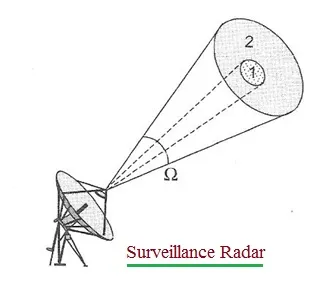
Surveillance radar systems determine a target’s range, angular position, and velocity. The radar beam is steered in both azimuth (horizontal) and elevation (vertical) directions. The total scanned volume is represented by a solid angle (Ω), as illustrated in the figure above.
There are two main types of surveillance radars:
- Primary Surveillance Radar (PSR): Detects targets by bouncing a signal off of them.
- Secondary Surveillance Radar (SSR): Relies on a transponder on the target to actively respond to the radar signal.
Both PSR and SSR have their own set of advantages and disadvantages, which we’ll discuss below.
Benefits or Advantages of Surveillance Radar
- Wide Coverage: Employs a large beamwidth in elevation and often uses stacked beams in azimuth for enhanced coverage.
- Long-Range Detection: Capable of detecting targets at long distances. Aircraft can be detected from approximately 400 kilometers away.
- High Power: Operates with high power levels, ranging from hundreds of kilowatts to several megawatts.
- Rapid Scanning: Uses a fan-shaped beam allowing it to scan a large volume of space quickly. Furthermore, the ability to steer the beam in both azimuth and elevation provides flexibility. This is why it is also known as “Search Radar.”
- Continuous Scanning: Can continuously scan beams, ensuring constant monitoring of the airspace.
- Enhanced Security: Provides security against attacks, especially during nighttime and in conditions of poor visibility.
- Target Detection and Ranging: Detects targets and accurately determines their range.
- 360-Degree Surveillance: Offers 360-degree surveillance from the surface to high altitudes.
- Bearing Determination: Determines the bearings (direction) of targets over a large area.
- SSR Capabilities: SSR systems not only detect aircraft but also provide altitude and identity information.
Drawbacks or Disadvantages of Surveillance Radar
- Large Infrastructure: Requires a large antenna, transmitting section, and receiving section. This usually limits its use to static, strategically located installations.
- PSR Limitations: Primary Surveillance Radar (PSR) can suffer from issues related to high power requirements, clutter (unwanted signals), and difficulty in identifying targets.
- SSR Dependency: Secondary Surveillance Radar (SSR) relies on targets having a transponder. It won’t detect targets without one.
These disadvantages of PSR are addressed to a large extent by using SSR.
Summary
Surveillance radar plays a critical role in air traffic control, military defense, maritime safety, border security, and weather monitoring by providing continuous target detection and tracking. Its monitoring advantages greatly enhance operational awareness, although interference mitigation and infrastructure investment remain important considerations.
Explore More Radar Types & their working
| AESA Radar Working & Benefits | AESA Vs. PESA Radar | Angle Vs. Monopulse Tracking Radars | ARSR and ASR Airport Surveillance Radar | Automotive Radar | Coherent Vs. Non-Coherent MTI Radar | CW Radar | Doppler Radar | FMCW Radar | Frequency Scanned Radar | Ground Penetrating Radar | HFSWR Radar for aircraft detection | Millimeter Wave Radar | Missile Seeker Radar | Monopulse & Conical Scan Radar | Monostatic & Bistatic Radar | MTI Radar | Over The Horizon Radar | Pulsed Radar | Search & Tracking Radar | TWS Radar | UWB Radar | Weather Radar | X-Band Radar |
Continue Learning Radar Technology
- Radar Tutorial: Types and Applications
- Radar Architecture Components & Functions
- Radar Duplexers: Types and Functionality
- Radar Classifications or Types
- Radar : Key Advantages & Disadvantages
- Radar Frequency Bands Chart
- Radar - Transmitter & Receiver Measurements
- Active Radar Vs. Passive Radar : Key Differences
- Radar Terminologies