
What is Fractal Antenna? 4 Types, Advantages & Applications
Advertisement
A fractal antenna is a compact antenna that uses self similar geometric patterns to achieve efficient multiband or wideband performance within a limited physical size. By repeating the same geometric shape at different scales, fractal antennas increase the effective electrical length without significantly increasing the antenna dimensions. Their unique characteristics make them suitable for modern wireless communication systems including Wi-Fi, Bluetooth, cellular networks (4G, 5G), GPS, satellite communication, military radios, and Internet of Things (IoT) devices.
4 Types of Fractal Antennas
A fractal antenna uses these complex, repeating geometric patterns to drastically increase the electrical length of the antenna without increasing its physical size.
By folding and repeating the conductive material into a fractal shape, engineers can cram a very long antenna path into a highly compact area. Because the pattern repeats at different scales, different parts of the antenna naturally resonate at different frequencies. This allows a single, small fractal antenna to operate across multiple bands (multi-band) or a very wide range of frequencies (wideband).
Fractal antennas come in several recognizable geometric shapes, each offering unique performance characteristics.
The Koch Fractal
It starts as a straight line. The middle third of the line is removed and replaced with two sides of an equilateral triangle. This process is repeated iteratively on every straight segment, creating a jagged, snowflake like edge. Key features are as follows.
- Excellent wideband performance.
- Good impedance matching (reducing signal reflection and loss).
- Multi-resonance capabilities.
Minkowski Fractal
This design typically begins with a square. Each side is divided into three parts, and a smaller square is added outward (or subtracted inward) at the middle section. This square edge pattern repeats. Key features are as follows.
- Exceptional for size miniaturization.
- Increased bandwidth.
- Strong harmonic suppression (filtering out unwanted noise/frequencies).
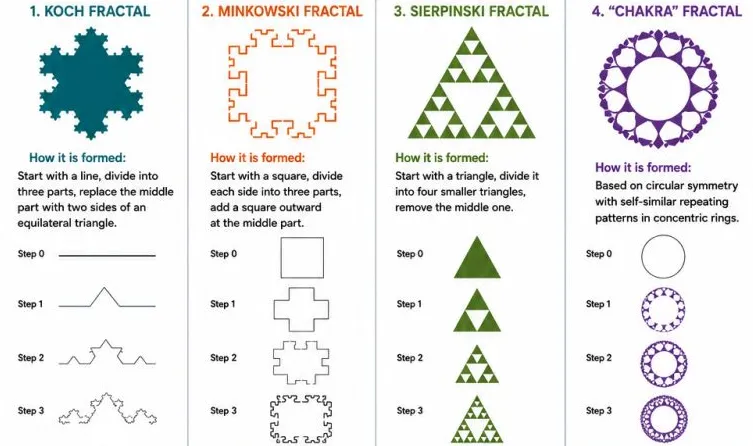
Sierpinski Fractal
Perhaps the most famous fractal, it starts as a solid equilateral triangle. It is then divided into four smaller triangles, and the central, inverted triangle is removed. This “triangle within a triangle” pattern repeats infinitely. Key features are as follows.
- Highly effective multi-band behavior (perfect for devices needing cellular, Wi-Fi, and GPS on one chip).
- Very lightweight structure.
- Simple and efficient design for manufacturing.
”Chakra” Fractal
Unlike the angular designs above, the Chakra fractal is based on circular symmetry. It utilizes self similar repeating patterns arranged in concentric rings. Key features are as follows.
- Produces circular polarization, which is crucial when the orientation of the transmitter and receiver is constantly changing (like a drone flying or a moving satellite).
- Ultra wideband capabilities.
- High radiation efficiency.
Advantages of Fractal Antenna
The primary benefits of fractal antennas are as follows.
- They provide significant electrical length within a minimal physical footprint, allowing for smaller devices.
- A single fractal antenna can replace multiple traditional antennas, supporting various frequencies simultaneously.
- The natural geometry helps match the antenna to the circuit, reducing power loss and improving battery life in portable devices.
- Because they can be easily printed as 2D traces onto standard Printed Circuit Boards (PCBs), they are virtually weightless and take up no vertical space.
- Their planar (flat) structure makes them incredibly easy and cheap to fabricate using standard manufacturing processes.
Applications of Fractal Antenna
- 5G & 6G Communications: Handling the massive bandwidth and multiple frequency bands required for modern cellular networks.
- IoT & Smart Devices: Allowing tiny smart home sensors to maintain reliable wireless connections.
- Wearable Technology: Fitting complex communication abilities into smartwatches and fitness trackers where space is severely limited.
- Drones & UAV Systems: Providing lightweight, circularly polarized antennas that maintain connection regardless of how the drone pitches or rolls.
- Satellite Communication: Reducing the payload weight on satellites while maintaining multi-band capabilities.
- Radar & Defense Systems: Utilizing wideband fractal arrays for advanced scanning and detection.
- Wi-Fi / WLAN Systems: Powering the multi-band routers in our homes and offices.
Summary
Fractal antennas offer compact size, multiband operation, and efficient radiation characteristics through innovative geometric designs. Their versatility makes them an attractive choice for space constrained RF and wireless communication applications.
Continue Learning About Antenna Technology
- Antenna Basics Tutorial
- Antenna Related Terms
- Antenna mechanical Vs. electrical tilt
- Difference between antenna gain directivity efficiency
- Antenna gain & effective area
- Bandwidth Vs. beamwidth antenna difference
- Antenna Factor
- Near field Vs. Far field antenna radiation pattern
Explore Different Types of Antennas
-
Check-out: Guide to List of Antenna Types >>