
What is 8B/10B Encoding : Advantages and Disadvantages
Advertisement
8B/10B encoding is a line coding technique that converts 8-bit data into 10-bit symbols to maintain DC balance and improve synchronization. Advantages include reliable clock recovery and error detection support, while disadvantages include 25 % bandwidth overhead and increased encoding complexity. It is widely used in high speed communication systems.
8B/10B Encoding Procedure
8B/10B is a block coding technique that, similar to 4B/5B encoding, uses redundancy to ensure synchronization and improve performance. It also offers inherent error detection capabilities. The name “8B/10B” signifies that the encoding process takes 8-bit blocks as input and produces 10-bit blocks as output.
The 8B/10B block coding scheme is a combination of 5B/6B and 3B/4B encoding, as illustrated below:
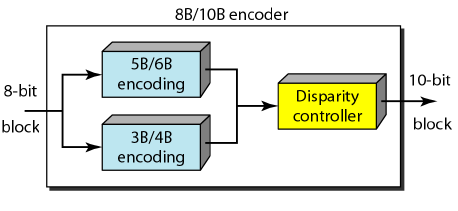
The most significant bits (MSBs) of the 8-bit block are fed into a 5B/6B encoder, while the 3 least significant bits (LSBs) are fed into a 3B/4B encoder module. The coding has 210 - 28 redundant groups.
Advantages of 8B/10B Encoding
- Disparity Control: It employs a disparity controller to keep track of excess 0s over 1s (or vice versa). This helps to prevent long runs of consecutive 0s or 1s, which can cause synchronization issues.
- Error Detection: The redundant groups can be used for disparity checking and error detection, improving the reliability of the transmitted data.
- Superior to 4B/5B: It offers better performance than 4B/5B coding due to its built-in error checking capability and improved synchronization.
Disadvantages of 8B/10B Encoding
- Overhead: The redundant data introduces overhead, increasing the overall bandwidth requirements.
Summary
8B/10B encoding improves synchronization and signal integrity in digital communication systems. Advantages include DC balance and clock recovery, while disadvantages include additional bandwidth requirements.
Advertisement


