
RF Filters: Butterworth vs Chebyshev vs Bessel vs Elliptic
Advertisement
In RF and microwave engineering, a filter’s physical construction (e.g. cavity, thin film or lumped element) is only half of the design equation. The other half is the electrical response; the mathematical approximation that dictates how the filter transitions from accepting signals (in the passband) to rejecting them (in the stopband).
Because it is physically impossible to create a perfect filter that instantly blocks unwanted frequencies without affecting the desired ones, engineers must choose between four classical mathematical responses viz. Butterworth, Chebyshev, Bessel and Elliptic. Each response trades one performance metric (like amplitude flatness) to optimize another (like steepness of the cutoff). Let us explore these four classical RF filter responses, how they work and compare them.
1. Butterworth Filters: Flat & Smooth
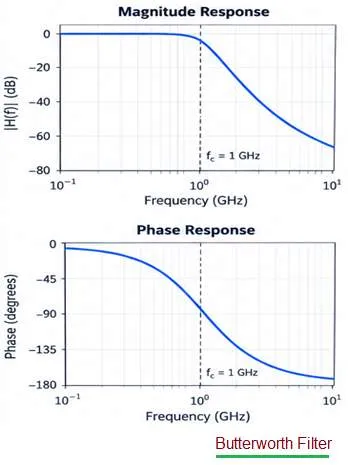
The Butterworth filter is designed to have the flattest possible amplitude response in the passband. This means there is no “ripple” (i.e. bouncing up and down of signal strength) before the cutoff frequency.
- The Trade off: The price paid for this perfectly flat amplitude is a very gradual, gentle roll-off into the stopband. To achieve strong rejection of adjacent, unwanted channels, a Butterworth filter requires a much higher filter “order” (meaning more physical components, which increases size and insertion loss).
- Best For: Broadband instrumentation, test & measurement systems and applications where absolute amplitude accuracy is critical.
2. Chebyshev Filters: Fast & Ripple (Passband)
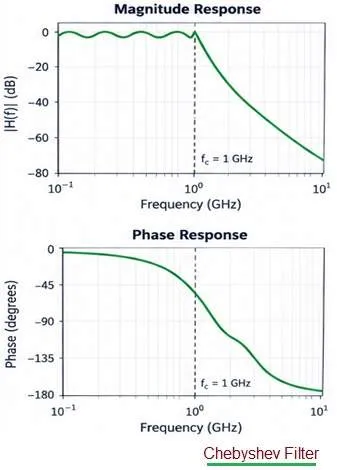
Chebyshev filters are designed to achieve a steeper transition (i.e. faster roll-off) between the passband and the stopband than a Butterworth filter.
- The Trade off: To achieve this sharper cutoff, Chebyshev filters intentionally introduce a controlled amount of amplitude ripple in the passband. The designer can tune this accepting more ripple yields an even steeper cutoff.
- Best For: General purpose RF communications. Because they offer an excellent compromise between circuit complexity (i.e. filter order) and frequency selectivity, they are one of the most commonly used filters in the industry.
3. Elliptic (Cauer) Filters : Sharpest & Double Ripple
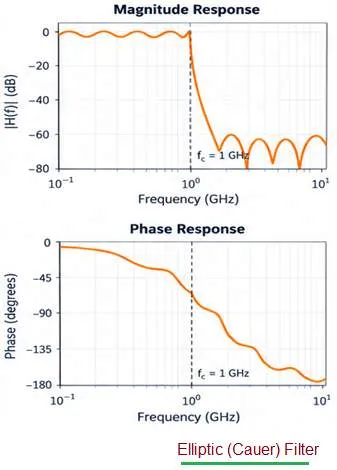
If your primary goal is to isolate signals that are incredibly close to one another in frequency, the Elliptic filter (also known as a Cauer filter) is the answer. It achieves the sharpest, steepest possible transition from passband to stopband of any classical filter design by introducing “transmission zeros.”
- The Trade off: Elliptic filters are the most chaotic in terms of amplitude. They exhibit ripple in both the passband and the stopband. Furthermore, they have highly nonlinear phase responses, which can severely distort pulse shapes.
- Best For: Highly congested spectrum environments, radar, Electronic Warfare (EW) and satellite communications where immediate, high rejection of a closely adjacent interferer is absolutely essential.
4. Bessel Filters: Linear Phase
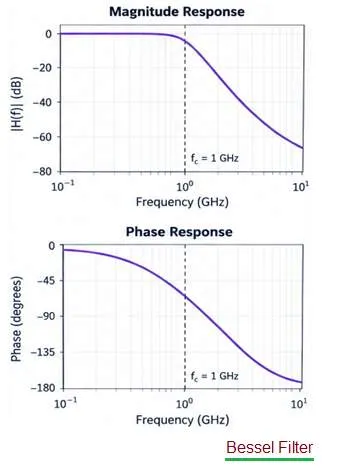
While the previous three filters focus entirely on signal amplitude (i.e. strength or magnitude), the Bessel filter focuses on signal phase (or timing). In RF systems passing digital pulses or complex modulated waveforms, different frequencies traveling at slightly different speeds through a filter will cause the signal pulse to smear or distort (a phenomenon known as group delay variation). The Bessel filter is designed to have a perfectly linear phase response and constant group delay, ensuring all frequencies pass through at the same time.
- The Trade off: Bessel filters have the most gradual, gentlest attenuation skirts (roll off) of all the classical filters. They are very poor at abruptly rejecting adjacent frequencies.
- Best For: Pulse transmission, time domain measurements and high speed digital/RF applications where preserving the exact waveform fidelity and shape is more important than aggressive frequency rejection.
Comparison: Differences Between Classical RF Filters
| Filter Type | Passband Amplitude | Stopband Amplitude | Roll-Off (Selectivity) | Phase Linearity (Group Delay) | Primary Superpower | Ideal Application |
|---|---|---|---|---|---|---|
| Butterworth | Maximally Flat (No Ripple) | Monotonic (Smooth) | Gradual / Slow | Moderate | Perfect amplitude accuracy in the passband. | Measurement equipment, broad instrumentation. |
| Chebyshev | Rippled | Monotonic (Smooth) | Steep / Fast | Poor | Great balance of steep cutoff with fewer components. | Standard RF communications, general purpose. |
| Elliptic (i.e. Cauer) | Rippled | Rippled | Sharpest (“Brick Wall”) | Very Poor | Aggressive rejection of closely adjacent frequencies. | Crowded spectrums, EW, Satellite comms. |
| Bessel | Drooping / Gentle | Monotonic (Smooth) | Very Gradual / Sluggish | Excellent (Constant) | Preserves the physical shape of a waveform/pulse. | Pulse transmission, time domain systems. |
Summary
Choosing the right filter response is an exercise in prioritization.
- If you cannot tolerate amplitude distortion, choose Butterworth.
- If you need a sharp cutoff but want a simple design, choose Chebyshev.
- If you need to instantly block a frequency right next to your signal, choose Elliptic.
- If you are transmitting pulses and cannot afford waveform smearing, choose Bessel.
Continue Learning Filter Fundamentals & Terminology
- Lumped Element Filter : Key Advantages & Disadvantages
- Microstrip Based RF Low Pass Filter Design Example
- Understanding Filter Terms
- RF Filters : Types, Selection Guide, Advantages & Disadvantages
- Active vs Passive Filters
- Analog vs Digital Filters
- Butterworth, Chebyshev, Bessel, and Elliptic Filters
- FIR Filter vs IIR Filter
- Understanding CIC (Cascaded Integrator-Comb) Filters
- Pi Filter: Advantages & Disadvantages
- Active vs Passive Harmonic Filters