
Wi-Fi 8 DRU Calculator: Spreading Gain & Uplink Formula
Advertisement
As the industry moves toward the next generation of wireless connectivity with IEEE 802.11bn, popularly known as Wi-Fi 8, the focus has shifted from raw peak speeds to Ultra High Reliability (UHR). One of the most significant innovations in this new standard is the Distributed-tone Resource Unit (DRU). Designed specifically to overcome strict Power Spectral Density (PSD) limits in the 6 GHz band, DRUs allow devices to spread subcarriers across a wider bandwidth rather than bunching them together.
This technique unlocks a critical “Spreading Gain,” which provides a massive boost to uplink transmit power. By leveraging Spreading Gain, Wi-Fi 8 ensures that even low power smartphones and IoT sensors can maintain high speed, reliable connections at distances that would have caused previous standards to fail. This page covers professional Wi-Fi 8 DRU Spreading Gain Calculator to help you quantify range improvements and signal reliability for next-gen devices.
EXAMPLE:
INPUTS:
- Dru_type (str) : ‘DRU26’, ‘DRU52’, ‘DRU106’, ‘DRU242’, ‘DRU484’
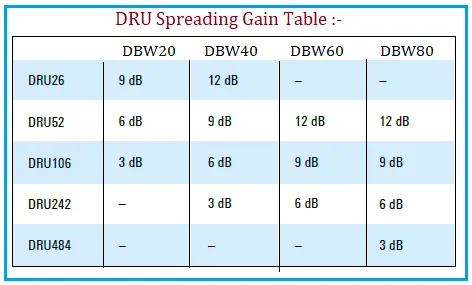
- dbw (int) : 20, 40, 60, 80 (Distribution Bandwidth in MHz)
OUTPUT:
- DRU spreading gain = 12 dB
Wi-Fi 8 DRU Spreading Gain Formula as per 802.11bn
The following table is used to derive or trace spreading gain based on DRU_Type and DBW value.
Summary:
The introduction of Distributed tone Resource Units (DRUs) marks a fundamental change in how Wi-Fi manages the uplink link budget. Our Wi-Fi 8 DRU Calculator serves as a valuable tool in 802.11bn development and planning.
References :
- IEEE 802.11bn draft amendment
- Research Papers on Wi-Fi 8
Explore More Wi-Fi 8 Calculators
- Wi-Fi 8 Data Rate Calculator
- Wi-Fi 8 DRU Subcarrier Index Calculator
- Wi-Fi 8 Latency Calculator
- Wi-Fi 8 Total Path Loss Calculator
Continue Learning Wi-Fi 8 Technology
- Wi-Fi 8 Physical and MAC Layer Overview
- Wi-Fi 8 Frame Formats
- Wi-Fi 8 Pillars and its Benefits
- Wi-Fi 8 MAC Table
Explore Wi-Fi 8 Technology Essentials
- Wi-Fi 8 Multi-AP Coordination Compared: Co-BF Vs. Co-SR
- Wi-Fi 8 Co-TDMA Vs Co-RTWT : Key Comparison
- Wi-Fi 8 Power Management: DPS and MLPM Explained
- Wi-Fi 8 Enhanced Long Range : Key Benefits
- Wi-Fi 8 Frame Formats : UHR MU PPDU vs. UHR TB PPDU
- Wi-Fi 8 Non-Primary Channel Access : Key Benefits
- Wi-Fi 8 RRU Vs DRU : Key differences
- Wi-Fi 8 Seamless Mobility Domain (SMD) : Key Benefits
- Wi-Fi 8 Standard EDCA Vs Priority EDCA
- Wi-Fi 8 Unequal Modulation (UEQM): key Benefits