
Wi-Fi 8 DRU Subcarrier Index Calculator & Kshift Formula
Advertisement
Unlike legacy standards where tones were always adjacent, Wi-Fi 8 introduces non-contiguous tone mapping to bypass Power Spectral Density (PSD) limitations. To calculate where these tones land in wide channels (80, 160, or 320 MHz), engineers must use the Kshift Formula. This page provides a professional Wi-Fi 8 DRU Subcarrier Index Calculator to simplify your development workflow.
EXAMPLE:
INPUTS:
- Select Subblock Size (20, 40, 60 or 80 MHz) = 20
- Select Channel Bandwidth (CBW) (80, 160, or 320 MHz) = 320
- Select Subblock Index (l) (e.g., 0 to 15 for 320 MHz) = 5
OUTPUT:
- Kshift = -645
What is Distributed tone Resource Unit (DRU) ?
In previous generations (Wi-Fi 6 and 7), we used Regular Resource Units (RRU), where subcarriers were grouped into a single contiguous block of frequency. While efficient for throughput, RRUs often hit regulatory power limits in the 6 GHz band because too much energy is concentrated in one spot.
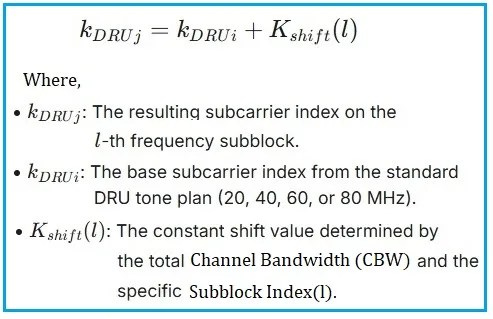
Wi-Fi 8 DRUs solve this by “scattering” the tones across a wider Distribution Bandwidth (DBW). This allows for higher transmit power per tone, significantly improving the uplink range. However, this scattering makes frequency mapping much harder, requiring a specific constant shift value known as Kshift.
Wi-Fi 8 DRU Subcarrier Index Formula as per 802.11bn
The following table is used to derive or trace Kshift as per three inputs viz. sub block size, channel bandwidth (CBW) and sub block index (l).
Summary:
This DRU subcarrier Index calculation tool automates the lookup of table mentioned in the 802.11bn standard which allowing you to find DRU subcarrier index quickly.
References :
- IEEE 802.11bn draft amendment
- Research Papers on Wi-Fi 8
Explore More Wi-Fi 8 Calculators
- Wi-Fi 8 Data Rate Calculator
- Wi-Fi 8 DRU Uplink Power Spreading Gain Calculator
- Wi-Fi 8 Latency Calculator
- Wi-Fi 8 Total Path Loss Calculator
Continue Learning Wi-Fi 8 Technology
- Wi-Fi 8 Physical and MAC Layer Overview
- Wi-Fi 8 Frame Formats
- Wi-Fi 8 Pillars and its Benefits
- Wi-Fi 8 MAC Table
Explore Wi-Fi 8 Technology Essentials
- Wi-Fi 8 Multi-AP Coordination Compared: Co-BF Vs. Co-SR
- Wi-Fi 8 Co-TDMA Vs Co-RTWT : Key Comparison
- Wi-Fi 8 Power Management: DPS and MLPM Explained
- Wi-Fi 8 Enhanced Long Range : Key Benefits
- Wi-Fi 8 Frame Formats : UHR MU PPDU vs. UHR TB PPDU
- Wi-Fi 8 Non-Primary Channel Access : Key Benefits
- Wi-Fi 8 RRU Vs DRU : Key differences
- Wi-Fi 8 Seamless Mobility Domain (SMD) : Key Benefits
- Wi-Fi 8 Standard EDCA Vs Priority EDCA
- Wi-Fi 8 Unequal Modulation (UEQM): key Benefits