
Wi-Fi 8 Co-TDMA vs Co-RTWT: Working, Benefits & Comparison
Advertisement
Introduction : In the legacy world of wireless networking, Access Points (APs) operated like individual speakers in a crowded room, each waiting for period of silence to begin talking. This “listen before talk” approach often led to inefficiency and collisions, especially in dense environments. Wi-Fi 8 (IEEE 802.11bn) introduces a collaborative framework known as Multi-AP Coordination (MAPC). Two of its most powerful time management features are Coordinated TDMA (Co-TDMA) and Coordinated Restricted Target Wake Time (Co-RTWT). These tools transform how airtime is managed, moving from a competitive model to a cooperative one. In this page, we will understand how Co-TDMA and Co-RTWT work and explore their benefits and derive difference between them.
Coordinated TDMA (Co-TDMA)
This technique allows an Access Point (AP) that has successfully won a “Transmission Opportunity” (TXOP) to share a portion of that time with neighboring, non collocated Access Points (APs). In previous Wi-Fi versions, if AP-1 won the right to talk, AP-2 had to sit in silence until AP-1 was completely finished. With Co-TDMA, AP-1 can act as a “time donor.”
How Co-TDMA works:
Following are three distinct phases involved in the Co-TDMA process.
Step-1. Polling: The “Coordinating AP” announces it has extra time and asks nearby APs if they have high-priority data to send.
Step-2. Allocation: The Coordinating AP assigns a specific slice of its remaining TXOP to a “Coordinated AP.”
Step-3. Potential Return: If the Coordinated AP finishes its task early, it can “return” the remaining time to the original donor, ensuring no millisecond of airtime is wasted.
Benefits of Co-TDMA:
This technique significantly reduces contention and collisions. By allowing APs to pass the “microphone” to each other without re-contending for the medium, the network becomes much more efficient. This is particularly beneficial for low latency traffic, as neighboring AP does not have to wait for a new contention window to send an urgent packet.
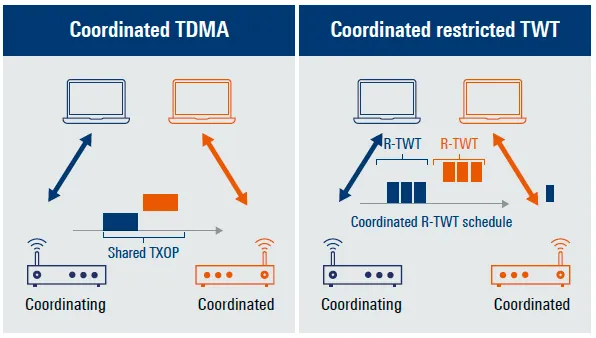 Image Courtesy : Rohde & Schwarz
Coordinated Restricted TWT (Co-RTWT)
This technique was introduced in Wi-Fi 7 to reserve specific time slots for ultra low latency applications such as VR or industrial sensors. However, it had a major flaw; it only worked within a single network (BSS).
A neighbor’s router (OBSS) had no idea your router had reserved that time and could accidentally blast data over your “protected” slot. Coordinated Restricted TWT (Co-RTWT) fixes this by allowing APs to share their schedules with their neighbors.
How Co-RTWT works:
Following steps illustrate how it works.
Step-1. The Request: An AP running a sensitive application (the Requesting AP) shares its R-TWT schedule with its neighbor (the Coordinated AP).
Step-2. The Protection: The Coordinated AP agrees to respect this schedule. It ensures that its own transmissions end before the neighbor’s protected window begins.
Step-3. The Beacon: The Coordinated AP advertises this schedule in its own beacons so that even its own connected devices know to stay quiet during that time.
Benefits of Co-RTWT:
The primary benefit of Co-RTWT is Deterministic Reliability. By preventing “Overlapping BSS” interference during critical wake times, Co-RTWT ensures that time-sensitive data arrives exactly when it is supposed to. This makes Wi-Fi 8 suitable for high stakes environments like smart factories or synchronized AR/VR experiences where even a 5ms interference spike is unacceptable.
Comparison between Co-TDMA and Co-RTWT
| Feature | Coordinated TDMA (Co-TDMA) | Coordinated Restricted TWT (Co-RTWT) |
|---|---|---|
| Action | Active sharing of an existing TXOP | Proactive protection of a future schedule |
| Focus | Reduces contention and airtime waste | Eliminates cross network interference |
| Phase | Real time (during transmission) | Scheduled (planned in advance) |
| Analogy | Passing the conch in a meeting | Reserving a quiet room for a conference call |
| Primary advantage | Higher aggregate throughput | Guaranteed low latency windows |
Summary
Together, Co-TDMA and Co-RTWT represent a shift toward infrastructure level intelligence. Wi-Fi 8 recognizes that the airwaves are a shared resource. By allowing APs to share time (using Co-TDMA) and protect schedules (using Co-RTWT), Wi-Fi 8 delivers a “wired like” consistency. For the end user, this means a network that is smarter, quieter and infinitely more reliable.
Continue Learning Wi-Fi 8 Technology
- Wi-Fi 8 Physical and MAC Layer Overview
- Wi-Fi 8 Frame Formats
- Wi-Fi 8 Pillars and its Benefits
- Wi-Fi 8 MAC Table
Explore Wi-Fi 8 Technology Essentials
- Wi-Fi 8 Multi-AP Coordination Compared: Co-BF Vs. Co-SR
- Wi-Fi 8 Power Management: DPS and MLPM Explained
- Wi-Fi 8 Enhanced Long Range : Key Benefits
- Wi-Fi 8 Frame Formats : UHR MU PPDU vs. UHR TB PPDU
- Wi-Fi 8 Non-Primary Channel Access : Key Benefits
- Wi-Fi 8 RRU Vs DRU : Key differences
- Wi-Fi 8 Seamless Mobility Domain (SMD) : Key Benefits
- Wi-Fi 8 Standard EDCA Vs Priority EDCA
- Wi-Fi 8 Unequal Modulation (UEQM): key Benefits