
Reflector Antenna Feed Types: Designs, Benefits & Applications
Advertisement
Feed types in reflector antennas determine how RF energy is launched toward the reflector and significantly influence antenna gain, radiation pattern, efficiency, bandwidth, and mechanical design. Common reflector antenna feed arrangements include prime focus feed, Cassegrain feed, Gregorian feed, offset feed, and horn or dipole based feed configurations.
Front (Axial) Feed (Also known as Prime Focus)
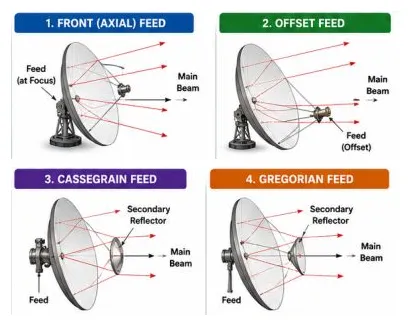
This is the most basic design. The feed is placed precisely at the focal point directly in front of the center of the dish, supported by structural arms.
Drawback : Because the feed and its support struts sit directly in the path of the main radio beam, they cast a “shadow.” This is called aperture blockage. It causes signal loss and creates scattered radiation (higher sidelobes).
Applications: Due to its simple structure and low cost, it is typically used in older designs or smaller, low cost systems where slight inefficiencies are acceptable.
Offset Feed
To solve the blockage problem of the Front Feed, engineers essentially cut an asymmetrical section out of a larger parabola. This moves the focal point and therefore the feed down and out of the way of the main signal path.
Benefits: Zero blockage. Because nothing is in front of the reflecting surface, these antennas offer excellent efficiency and very low sidelobes (less interference).
Applications: This is the standard design for modern consumer satellite TV dishes (DTH), broadband internet terminals (VSATs), and cellular backhaul antennas.
Cassegrain Feed (Dual Reflector)
Instead of putting the bulky feed horn and radio electronics out on arms in front of the dish, a Cassegrain system uses a two mirror approach. A small, convex (bulging outward) secondary reflector is placed at the focal point. The actual feed is located in a hole at the very back (vertex) of the main dish. The feed shoots the signal forward, it hits the sub-reflector, bounces back to the main dish and then blasts out into space.
The Benefits: It moves heavy electronics to the back of the dish, making the antenna easier to balance, install, and maintain.
Applications: Because it requires a larger dish to be effective, it is widely used in massive earth station antennas, satellite communications hubs, and radar tracking systems.
Gregorian Feed (Dual Reflector)
Very similar to the Cassegrain design, but the secondary sub-reflector is concave (bowl shaped / ellipsoidal) rather than convex.
The Benefits: The geometry of the Gregorian sub-reflector allows for even finer control over how the main dish is illuminated. It provides exceptionally high aperture efficiency and extremely clean radiation patterns.
Applications: This high complexity, high efficiency design is reserved for applications where absolute maximum performance is required, such as deep space communication networks and radio astronomy.
Summary
From this article we have learnt that reflector antenna feed types control how RF energy illuminates the reflector and directly affect gain, efficiency, bandwidth, and radiation pattern.
Explore Different Types of Antennas
-
Check-out: Guide to List of Antenna Types >>