
What is Fractal Antenna : Advantages and Disadvantages
By RF Wireless Expert Team
Advertisement
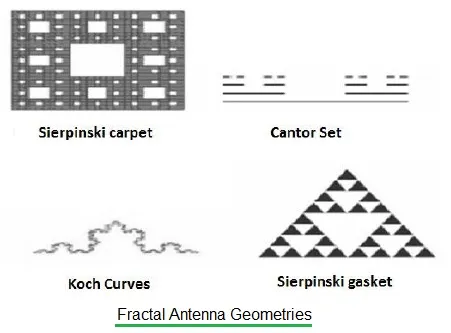
A fractal antenna uses self similar geometric patterns to achieve compact size and multiband operation. It is commonly used in wireless communication, IoT devices, military systems, and mobile equipment. Advantages include reduced antenna size and wideband performance, while disadvantages include design complexity and challenging manufacturing requirements.
Advantages of Fractal Antenna
- Miniaturization: Fractal antennas can be made significantly smaller than traditional antennas.
- Better Input Impedance Matching: They offer improved matching of input impedance.
- Multi-band Capability: A single fractal antenna can often handle multiple frequency bands, both narrowband and wideband. This eliminates the need for multiple antennas.
- Consistent Performance Over a Wide Frequency Range: Fractal antennas provide consistent performance across a broad range of frequencies, making them nearly frequency-independent.
- Reduced Mutual Coupling in Antenna Arrays: When used in array antennas, the fractal geometry reduces mutual coupling between elements.
Disadvantages of Fractal Antenna
- Design and Manufacturing Complexity: The design and manufacturing processes are more complex compared to traditional antennas.
- Numerical Limitations: The simulation and analysis of fractal antennas can be computationally intensive and subject to numerical limitations.
- Gain Loss: Fractal antennas can sometimes exhibit gain loss compared to conventional antenna designs.
- Diminishing Returns with Iterations: After a few iterations in the fractal antenna design process, the benefits of this technology-based approach tend to diminish. The improvement gained with each additional iteration becomes smaller.
Summary
Fractal antennas deliver compact, multiband wireless communication solutions. Advantages include space efficiency and wide frequency coverage, while disadvantages include complex design and fabrication processes.