
What is Parabolic Reflector Antenna: Advantages and Disadvantages
Advertisement
A parabolic reflector antenna uses a curved reflective dish to focus electromagnetic waves toward a feed antenna, providing high gain and excellent directivity. It is widely used in satellite communication, radar, broadcasting, and deep-space communication due to its ability to transmit and receive weak signals efficiently.
Working principle of Parabolic Reflector Antenna
The parabolic reflector antenna is a widely used type of microwave antenna consisting of a parabolic dish and an antenna feed.
Various feed arrangements exist for parabolic reflector antennas, including:
- Center feed with spherical cell
- Center feed with horn antenna
- Cassegrain feed
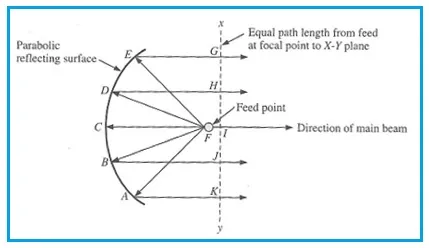 Parabolic Reflector Antenna working
This antenna type is used for both transmitting and receiving signals. As a transmitter (Figure 1), the feed radiates power onto the parabolic reflecting surface. The reflector then focuses the microwave power along the antenna axis, creating the beam direction. When receiving, waves impacting the dish are concentrated towards the feed, which is positioned at the focal point of the dish.
Benefits or Advantages of Parabolic Reflector Antennas
- Reciprocity: Can be used as both a transmitting and receiving antenna.
- Versatile Feed Options: The feed can be configured in various modes, such as center feed, cassegrain feed, or offset feed, each with its own benefits and applications.
- Smaller Size and Low Cost They are relatively compact and inexpensive.
Drawbacks or Disadvantages of Parabolic Reflector Antennas
- Radiation Blockage: The feed antenna and reflector disc can block a small percentage (about 1-2%) of radiation from the main reflector.
- Complex Design: Designing parabolic reflectors is a complex process.
- Side Lobes: Even with the feed horn at the focus and uniform illumination, some power from the feed spills over the edges of the reflector, contributing to side lobes in the radiation pattern.
- Surface Distortions: Very large dishes can experience surface distortions. Using a wide mesh instead of a continuous surface can mitigate this.
- Focal Point Accuracy: Achieving optimal performance requires placing the feed precisely at the focus of the parabolic reflector, which can be difficult in practice.
Summary
A parabolic reflector antenna uses a curved dish to focus radio waves into a narrow beam, providing high gain and long-distance communication. It is commonly used in satellite communication, radar, and television broadcasting.
Continue Learning About Antenna Technology
- Antenna Basics Tutorial
- Antenna Related Terms
- Antenna mechanical Vs. electrical tilt
- Difference between antenna gain directivity efficiency
- Antenna gain & effective area
- Bandwidth Vs. beamwidth antenna difference
- Antenna Factor
- Near field Vs. Far field antenna radiation pattern
Explore Different Types of Antennas
-
Check-out: Guide to List of Antenna Types >>