
Cellular IoT in Wildfire Prevention: Pros & Cons
Advertisement
Introduction : When it comes to fighting wildfires, emergency management relies on golden rule i.e. quelling a blaze within its first hour offers the best chance of containment.
Historically, humanity has relied on visual detection method such as human spotters in watchtowers, aircraft, and more recently, satellite imagery and pole mounted cameras. However, these optical methods have a fatal flaw. They rely on seeing smoke or flames above the tree canopy. By the time a fire grows large enough to produce a visible smoke plume through thick forest cover, it has often escalated beyond that critical first hour.
To solve this, technologists are shifting the focus from optical detection to chemical and thermal detection on the forest floor using Cellular IoT.
How it Works: Tree Mounted Sensors and Edge AI
Modern IoT wildfire solutions utilize networks of compact sensors mounted directly onto trees. These devices are equipped to monitor the microclimate, measuring variables such as temperature, humidity, air pressure and the presence of gases like carbon dioxide, carbon monoxide and volatile organic compounds (VOCs). But simply collecting this data isn’t enough; the magic happens through “Edge AI (Machine Learning at the edge)”.
Instead of continuously transmitting raw environmental data to the cloud which would rapidly drain the device’s battery; the sensor’s onboard microprocessor runs Machine Learning algorithms locally. The Edge AI is trained to recognize the specific, subtle environmental signatures of the “smoldering phase” (i.e. period before a fire actually bursts into open flames).
If the AI detects the specific combination of a sudden humidity drop, a temperature spike and rising CO2 levels, it immediately triggers an alarm.
The Role of Cellular IoT (NB-IoT)
Once the Edge AI detects a smoldering fire, it must transmit that alert to fire command centers. Because forests lack Wi-Fi and power lines, engineers turn to Cellular IoT, specifically NB-IoT (Narrowband IoT).
NB-IoT is a low power, wide area cellular technology designed specifically for machines. It is the perfect fit for the forest for two reasons:
- Exceptional Range and Penetration: NB-IoT signals can travel for miles and easily penetrate dense physical obstacles, like thick forest canopies, foliage and hilly terrain, better than standard 4G/5G smartphone signals.
- Ultra-Low Power: By keeping the modem asleep until the Edge AI wakes it up to send a tiny data packet (i.e. fire alert), the sensor can run on standard batteries for years.
Advantages of Cellular IoT for Wildfire Detection
- Detection in Smoldering Phase: Because the sensors are sniffing the air at the ground level rather than waiting for smoke to rise above the trees, authorities can be alerted to fire before it spirals out of control.
- Predictive Insights & Research: Beyond just sounding alarms, the data gathered by these sensors gives authorities a massive new dataset. By tracking wind, temperature and soil moisture trends, AI can predict where a fire is likely to break out next, allowing for targeted “hazard reduction” burns.
- Unblinking Vigilance: Unlike drones that must land to recharge, or satellites that only pass overhead periodically, IoT sensors are active 24/7/365, regardless of cloud cover, nighttime darkness or thick smoke.
- Cost Effectiveness: A full deployment of sensors across a high risk forest costs fraction of a percent of the billions of dollars it takes to fight a mega fire and rebuild destroyed communities.
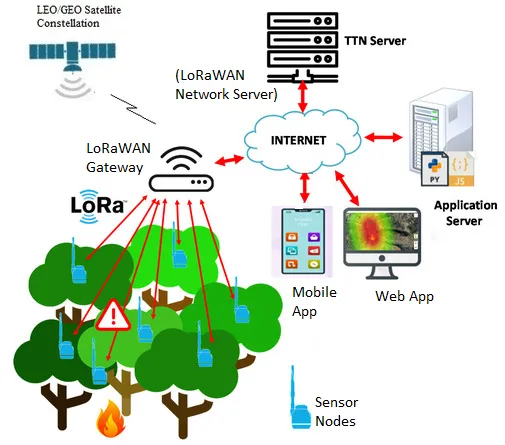 Figure-1: LoRaWAN WildFire Monitoring System Architecture
Disadvantages or Challenges of Cellular IoT in Wildfire Detection
- Connectivity Black Spots: While NB-IoT has excellent range, it still requires a cellular tower to be within several miles. In the deepest, most remote wildernesses on Earth, cellular infrastructure simply does not exist. In these cases, satellite IoT or localized mesh networks like LoRaWAN must be used instead. Refer LoRaWAN Based WildFire Detection System >>.
- Harsh Environmental Conditions: A forest is a hostile environment for electronics. Sensors must be ruggedized to withstand extreme heat, freezing winters, torrential rain and curious wildlife that might chew on or dislodge the devices.
- Deployment Logistics: Forests are vast and sprawling. Physically attaching sensors to thousands of trees by hand is incredibly labor intensive. Engineers are currently experimenting with aerially dropping low cost sensors from drones, but configuring a network this way remains a logistical hurdle.
- Strict Battery Limits: Because it is impossible to routinely change batteries in a forest containing tens of thousands of sensors, the hardware must be engineered perfectly. If the Edge AI draws too much power or the Cellular modem struggles to find a signal and drains the battery, the sensor becomes electronic litter.
Conclusion
Climate change is creating hotter, drier conditions that make forests highly combustible. While Cellular IoT and Edge AI cannot stop lightning from striking or a campfire from sparking, they offer the earliest possible warning system. By alerting first responders while a fire is still just a smoldering patch of brush, this technology provides the critical time needed to extinguish a threat before it becomes a catastrophe.
Explore More LoRaWAN Use Cases
- LoRaWAN Smoke Detector Design
- LoRaWAN Temperature & Humidity Sensor Design
- LoRaWAN Tracking Device Design
- LoRaWAN Gas Leakage Detection System Architecture
- LoRaWAN Smart Parking System Architecture
- LoRaWAN Smart Water Meter Architecture