
Micromobility IoT: Cellular vs Wi-Fi Pros & Cons
Advertisement
Urban transportation is undergoing a massive transformation. The rise of shared electric mobility (e-mobility) is reducing traffic congestion and lowering carbon footprints in cities worldwide. E-mobility vehicles include e-bikes, e-scooters and other lightweight electric vehicles.
However, a shared micromobility fleet is only as good as the technology connecting it. Operators need to know exactly where their vehicles are, users need to unlock them seamlessly and maintenance teams need remote diagnostic data to keep the fleet running.
When designing the connectivity architecture for an e-bike or e-scooter, engineers typically evaluate two primary wireless technologies: Cellular IoT (LTE-M and NB-IoT) and Wi-Fi (often paired with Bluetooth Low Energy). Here is a deep dive into how they compare, their pros and cons and how to design the ultimate micromobility use case.
What is Cellular IoT in Micromobility?
Cellular IoT, specifically Low Power Wide Area Network (LPWAN) technologies like LTE-M and NB-IoT, leverages existing city wide cellular infrastructure to connect devices directly to the Cloud over distances of several miles.
In micromobility, Cellular IoT is the backbone of fleet management. It allows a scooter parked on a random street corner to maintain a secure, low power connection to the operator’s central server. This enables real time GPS tracking, battery level monitoring and over the air (OTA) remote locking/unlocking.
Advantages of Cellular IoT (LTE-M / NB-IoT)
- Ubiquitous Coverage: As long as there is a cell signal, the vehicle is connected. This is critical for anti-theft tracking and ensuring users can always find and rent a vehicle via their smartphone map.
- Remote Diagnostics: Operators can stream real time telemetry (motor performance, tire pressure, battery health etc.). For example, companies using cellular diagnostics have seen vehicle lifespans increase by up to 5 years by predicting maintenance needs before catastrophic failures occur.
- No Local Gateways: Cellular IoT connects directly to the Cloud, eliminating the need for users to configure the vehicle to a local network.
Disadvantages of Cellular IoT
- Ongoing Data Costs: Cellular connections require a SIM or eSIM and incur monthly subscription fees paid to telecom operators.
- Power Consumption: While LTE-M and NB-IoT are low power, transmitting data to a cell tower kilometers away intrinsically uses more battery than transmitting to router a few feet away.
What is Wi-Fi in Micromobility?
Wi-Fi is a Local Area Network (LAN) technology designed for high data throughput over short distances (typically under 100 meters).
While a moving scooter cannot maintain a continuous Wi-Fi connection as it travels through a city, Wi-Fi is highly valuable in specific, stationary contexts. It is frequently used for consumer owned e-bikes (connecting to the user’s home network), for downloading massive firmware updates when a shared scooter is returned to a maintenance depot or in stationary e-mobility infrastructure like EV charging stations.
Advantages of Wi-Fi
- High Bandwidth: Wi-Fi can transfer large amounts of data very quickly. If a scooter has an integrated camera for sidewalk detection, Wi-Fi is ideal for offloading that heavy data when the vehicle reaches a hub.
- No Recurring Data Fees: Sending data over a local Wi-Fi network avoids cellular provider data charges.
- Indoor Locationing: In dense urban canyons or underground parking garages where GPS fails, Wi-Fi SSID sniffing can be used to approximate location.
Disadvantages of Wi-Fi
- Limited Range: Wi-Fi is entirely dependent on the vehicle being in range of a known hotspot. It is useless for real-time tracking while the vehicle is in transit.
- Power Drain on Search: If a device’s Wi-Fi radio is constantly pinging to search for a network while driving around a city, it will drain the vehicle’s battery incredibly fast.
Best Use Case Designs for Micromobility
Designing a modern e-bike or e-scooter doesn’t mean choosing just one technology; the best designs utilize a hybrid connectivity architecture.
1. The Shared Fleet E-Scooter Architecture
For rentable e-scooters, Cellular IoT is the primary radio.
- Hardware Design: Engineers should look for a highly integrated System in Package (SiP), such as the Nordic nRF9151, which combines an LTE-M/NB-IoT modem, application processor and GNSS (GPS) in a tiny footprint.
- Power Optimization: Because these scooters run on batteries that need to last multiple trips, developers must utilize cellular sleep modes like PSM (Power Saving Mode) and eDRX (extended Discontinuous Reception).
- Location Trade-off: GNSS consumes a lot of power. To save battery, developers can design the firmware to use precise GNSS only when the user is actively searching for the bike. When the bike is just sitting idle, the system can fall back on cellular tower triangulation (which is less precise but uses drastically less power).
- Bluetooth/Wi-Fi Companion: Add a low power Bluetooth LE / Wi-Fi companion chip. Bluetooth allows the user’s smartphone to communicate directly with the scooter for a frictionless unlock experience, even if cellular networks are congested. Wi-Fi can be activated only when the scooter returns to a charging depot to offload diagnostic logs.
2. The Smart EV Charging Station
For the infrastructure supporting micromobility, the design requirements flip.
- Hardware Design: Because EV charging stations are stationary and often wired into city grids, power consumption is less of an issue. Wi-Fi can act as the primary connection to local facility’s network.
- Cellular Fallback: However, Cellular IoT should be included as a reliable fallback. Research shows that remote monitoring of EV stations via cellular IoT decreases maintenance costs by 15 %, as operators can reboot systems or diagnose faults without sending a technician into the field.
Conclusion
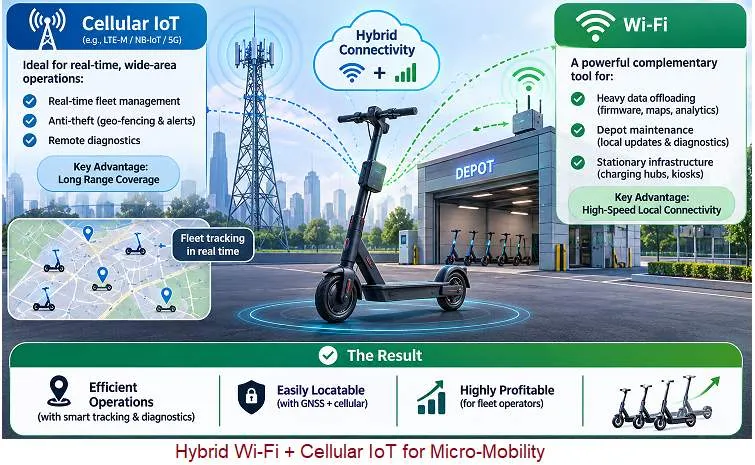
When designing for micromobility, Cellular IoT is preferable for real time fleet management, anti-theft and remote diagnostics due to its long range capabilities. Wi-Fi, on the other hand, remains a powerful complementary tool for heavy data offloading, depot maintenance and stationary infrastructure. By integrating both smartly, hardware engineers can build e-vehicles that are efficient, easily locatable and highly profitable for fleet operators.
Explore More LoRaWAN Use Cases
- LoRaWAN Smoke Detector Design
- LoRaWAN Temperature & Humidity Sensor Design
- LoRaWAN Tracking Device Design
- LoRaWAN Gas Leakage Detection System Architecture
- LoRaWAN Smart Parking System Architecture
- LoRaWAN Smart Water Meter Architecture