
BLE in Wearables: Architecture, Working, Benefits & Limitations
Advertisement
Bluetooth Low Energy (BLE) has become a key wireless technology for connected wearables such as smartwatches, fitness trackers, health monitors and smart accessories, where low power consumption, compact hardware, and reliable short-range communication are essential. This article explains BLE wearable architecture, how BLE works in wearable devices, hardware design considerations, communication protocols, power optimization and firmware implementation.
A typical BLE wearable combines a radio enabled microcontroller, sensors, power management, antenna, firmware and a BLE protocol stack to exchange data with a smartphone or gateway.
BLE Wearables System Architecture & its working
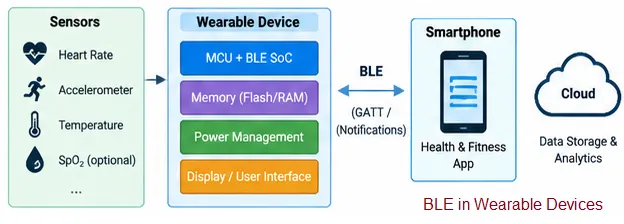
The figure depicts generic architecture of BLE wearable device. Wearable device typically consists of BLE SoC, Microcontroller Unit (MCU), Memory (Flash and RAM), Power Management IC, Display for user interface, keys or buttons, battery etc. Following steps describe working of this BLE wearable based system.
- Sensors collect health or fitness related data. Some of the sensors include heart rate, accelerometer, temperature, SpO2 etc.
- MCU processes data and sends it via BLE to a smartphone. Wearable device and smartphone communication using GATT/Notifications feature of BLE.
- Smartphone application displays data and may sync to the cloud servers for long term storage as well as analytics purpose.
- Firmware uses standard BLE profiles such as heart rate, thermometer, device information etc.
Benefits of BLE Wearables
-
Extended Battery Life: BLE’s ultra-low power consumption allows wearables with tiny batteries to operate continuously for days, weeks, or even months without needing a recharge.
-
Universal Compatibility: Native integration into almost all modern smartphones and tablets guarantees seamless, out of the box pairing and data syncing for users.
Limitations of BLE Wearables
-
Restricted Data Bandwidth: BLE’s relatively low data transfer rate makes it unsuitable for streaming heavy, continuous data payloads like high resolution audio or uncompressed video.
-
Smartphone Dependency: BLE’s short operational range effectively tethers the wearable to a host device, meaning it loses internet access and cloud connectivity if the user leaves their phone behind.
Conclusion
In summary, Bluetooth Low Energy (BLE) stands as the foundational technology driving the widespread adoption and continuous evolution of the modern wearable industry. By perfectly balancing ultra-low power consumption with universal smartphone interoperability, BLE enables smartwatches, fitness trackers, and medical monitors to seamlessly sync real-time data without rapidly depleting their tiny batteries.
While it is not designed for heavy data streaming, its exceptional efficiency in handling intermittent, small packet payloads such as heart rate metrics, step counts and push notifications; makes it the ideal wireless protocol for personal devices. Ultimately, as wearables become even more integrated into our daily health and smart home ecosystems, BLE will remain the essential, invisible tether connecting our physical activities to our digital lives.
Continue Learning More BLE Use Cases
- BLE Asset Tracking: Tags, Beacons, Gateways & Architecture
- BLE Digital Car Keys: Architecture, Working, Benefits & Limitations
- BLE Electronic Shelf Labels: Architecture, Working & Design
- BLE Smart Health Band: Architecture, Working, Hardware Design
Continue Learning Bluetooth Basic Concepts
- What are new features in Bluetooth 6.3 Version
- Bluetooth GATT Vs. ATT Vs. GAP : Key Comparison
- Bluetooth Service Vs. Characteristic Vs. Descriptor
- Bluetooth Central Vs. Peripheral : Key Differences
- Bluetooth pairing Vs. Bonding Phase
- Bluetooth Notifications Vs. Indications
- Bluetooth Channel Sounding Vs. RSSI
- Bluetooth Error Codes Guide : Meanings, Causes & Fixes
Continue Learning Bluetooth Technology
- Bluetooth Basics Tutorial
- Bluetooth Low Energy (BLE) Basics Tutorial
- Bluetooth Protocol Stack & Device State Diagram
- Bluetooth Physical Layer Modules
- Bluetooth MAC Layer Overview
- Bluetooth Channel Frequency List
- Bluetooth Network Security
- Bluetooth Low Energy (BLE) Connection Establishment Procedure
- Bluetooth Profiles: HFP, HSP, A2DP, AVRCP, PBAP & MAP
- Bluetooth Mesh Node Types & Protocol Stack Layer Functions
Compare Bluetooth With Other Technologies
- Bluetooth V5.0 Vs. V5.1 Vs. V5.2 Vs. V5.3
- Bluetooth Vs BLE : Key Differences
- Bluetooth Vs UWB Technology : Key Differences
- Bluetooth Vs Wi-Fi Vs UWB
Explore Deep Insight Bluetooth Technology
- Bluetooth AFH Explained: Adaptive Frequency Hopping & FAQs
- Bluetooth Error Recovery : ARQ, ACK, NAK
- Bluetooth Bit Stream Processing: HEC, CRC, FEC & More
- Bluetooth Routing: How Devices Know a Packet is for Them
- Bluetooth Flow Control: Understanding GO & STOP Bits
- Bluetooth Power Management: Sniff, Hold & Active Modes
- Bluetooth Packets Decoded: Structure, Types & Routing
- Decoding Bluetooth Packet Types: Control, ACL, SCO & eSCO