
What is Linear Polarization : Advantages and Disadvantages
Advertisement
Linear polarization occurs when an electromagnetic wave oscillates in a single plane during propagation. It is commonly used in antennas, satellite links, radar systems, and wireless communications. Advantages include simple implementation and high efficiency, while disadvantages include polarization mismatch losses and susceptibility to signal degradation in certain environments.
Introduction
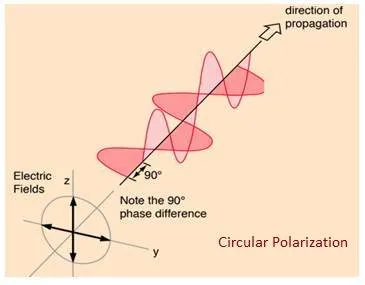
Polarization refers to the directional aspect of the electric field (E-field) within an electromagnetic (EM) radio signal. This characteristic allows for frequency reuse, ultimately enhancing satellite capacity.
There are two primary types of polarization:
- Linear Polarization
- Circular Polarization
Linear Polarization & its types
Linear polarization occurs when the electric field lies entirely within a single plane that contains the direction of propagation. This plane can be oriented in two main ways, leading to:
- Horizontal Polarization
- Vertical Polarization
Electromagnetic waves consist of both an electric field (E-field) and a magnetic field (H-field). These fields are perpendicular to each other, meaning they are 90 degrees out of phase.
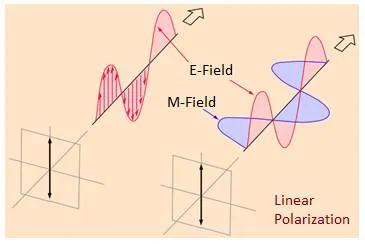
- Horizontal Polarization: The electric field lies in a plane parallel to the Earth’s surface.
- Vertical Polarization: The electric field lies in a plane perpendicular to the Earth’s surface.
Benefits or Advantages of Linear Polarization
- Better Cross-Polarization Isolation: Linear polarization provides improved isolation between signals with different polarizations.
- Lower Antenna System Cost: Antenna systems designed for linear polarization are generally less expensive.
- Longer Read Range for RFID: RFID readers using linear polarization can achieve a longer read range compared to those using circular polarization.
Drawbacks or Disadvantages of Linear Polarization
- Polarization Adjustment Required: Careful alignment and adjustment of polarization are necessary.
- Polarization Changes with Location: Polarization can change based on latitude and longitude.
- Increased Risk of Cross Polarization Interference: There is a higher chance of interference due to unwanted signals with different polarizations.
- Faraday Rotation: Linearly polarized waves are susceptible to Faraday rotation in the ionosphere.
- RFID Reader Limitations: Linear polarization-based RFID readers need to be on the same plane and height as the RFID tags. Moreover, the RFID reader needs to know the tag orientation.
Summary
Linear polarization is widely used in RF and communication systems for efficient signal transmission. Advantages include simplicity and effectiveness, while disadvantages include alignment sensitivity and polarization losses.