
What is RF MEMS : Advantages and Disadvantages
Advertisement
RF MEMS (Radio Frequency Micro-Electro-Mechanical Systems) are miniature mechanical devices that perform RF switching, tuning, and signal control functions. Their advantages include low power consumption, excellent isolation, and high linearity, whereas their disadvantages include fabrication complexity, packaging challenges, and relatively slower switching speeds than semiconductor devices.
RF MEMS devices are fabricated using Micromachining techniques. This technology evolved from semiconductor device fabrication processes, employing methods such as surface micromachining and bulk micromachining for MEMS integration.
Advantages of RF MEMS
- MEMS devices integrate both mechanical and electrical components on a micro scale.
- These devices are fabricated using IC batch processing methods, resulting in smaller sizes, typically ranging from nanometers to millimeters (generally 20 micrometers to 1 millimeter).
- MEMS devices offer better performance compared to non-MEMS devices, delivering low insertion loss, higher Q, and very low current consumption.
- They minimize energy and material usage, thus lowering costs.
- Various RF components, including RF switches, phase shifters, gyroscopes, accelerometers, sensors, oscillators, filters, and RF antennas, have been developed using this technology. RF MEMS switches are particularly useful in test and measurement applications due to their low switching time, low insertion loss, and high isolation characteristics.
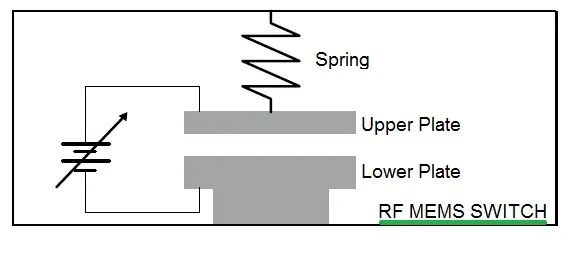
- RF MEMS devices are widely used across industries such as automotive (for measuring tire pressure, fuel pressure, oil pressure, etc.), biomedical (blood pressure sensors, implanted sensors, etc.), electronics, telecom, and defense.
- MEMS devices are used in inkjet and bubblejet printers.
- They improve reproducibility, sensitivity, accuracy, and reliability.
- Modifying parts of a MEMS device is easier compared to its macro counterpart.
Disadvantages of RF MEMS
- MEMS devices cannot handle very high power due to their size and the materials used in their construction (e.g., Poly-Si). RF scientists are actively working on developing RF MEMS devices with better material quality and the capacity to withstand high power.
- Initial setup and establishment require a significant investment.
- Polysilicon, often used in construction, is a brittle material.
- The design process can involve complex procedures and processes.
Summary
RF MEMS technology enables compact, high-performance RF components for wireless communication, aerospace, and defense applications. Its operational advantages support improved efficiency and miniaturization, although manufacturing complexity and long-term reliability continue to influence commercial deployment.
Continue Learning RF Technology
- What is RF Signal : Radio Frequency Fundamentals
- RF Related Terminologies
- RF Components & Their Basic Functions, Manufacturers
- What is RF Radiation: Safety, Uses & Health Concerns
Compare RF (Radio Frequency) with The Rest
- RF Vs. Microwave : Key Comparison
- RF Vs. Baseband : Key Differences Explained
- RF Vs. IF: Difference Between RF and IF Signals
- RF Vs. PHYSICAL LAYER : Key differences explained